Now freely downloadable worldwide, as a protest against censorship
The only Dutch book to overcome a full book ban:
Now freely downloadable worldwide, as a protest against censorship
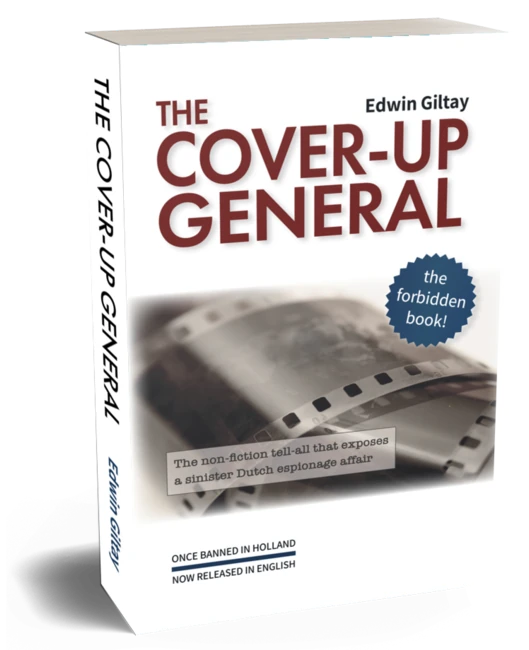
A general sporting three stars on his sleeve, sending a private spy to snoop around a civilian firm. And this is not just anyone: it’s the general’s own wife. A tribal war within the Dutch Military Intelligence Service, with unsuspecting citizens being victimised. You’d expect that in a totalitarian state, not in the Dutch lowlands. However, this is what author Edwin Giltay experienced – he vividly describes the saga in The Cover-up General (Dutch: De doofpotgeneraal).
In his book, Giltay depicts the rather transparent conduct of secret service agents infiltrating the internet provider where he worked. Initially, a spook tried to recruit Giltay as a military analyst. At the same time, however, she herself was being monitored. At the root of this tug-of-war within Dutch Military Intelligence was the infamous film roll of Srebrenica depicting war crimes, which the Dutch Armed Forces allegedly lost during development. The recruiting officer who approached Giltay wanted to make public that the photos had by no means been ruined – information that would no doubt have undermined the standing of a three-star general.
The Cover-up General chronicles this espionage scandal and serves as factual testimony to how this secret cover-up operation spun out of control. Nevertheless, in response to the affair Giltay was falsely declared insane by the Minister of Defence, and his book was banned after objections from military intelligence circles. The Court of Appeal of The Hague annulled the book ban. It saw no reason to doubt the author’s meticulousness. Moreover, the Court of Appeal affirmed the importance of the publication for the public debate on Srebrenica.
All these developments are set out in the free English edition.
Download and share it freely – as a tribute to the fight against censorship.
The Cover-up General
Written by: Edwin Giltay
English editor: Michael Wynne
The Hague, The Netherlands, 2025
292 pages, with colour illustrations
Why this international edition matters so much
This case is not a closed chapter. Featured in media worldwide, it goes to the heart of a functioning democracy:
•
For history:
The Mothers of Srebrenica cited the book in their lawsuit against the Dutch State as an indication that the notorious film roll, containing images of war crimes, had not failed and that the photos have been withheld ever since. The Supreme Court of the Netherlands ruled in that case, on other grounds, that the State is partially liable for the deaths of about 350 men.
•
For press freedom:
The Court of Appeal dismissed the doubts about the author’s meticulousness. With that, The Cover-up General set a globally rare precedent: a full book ban, reversed on appeal.
•
For state accountability:
The State speaks with contradictory voices. Asked whether the book is fake news or a conspiracy theory, Justice in effect answered no: that criticism is “in no way based” on its content. Defence dismissed it as a book in which “fact and fiction do indeed become intertwined”. The Standing Committee on Defence of the Dutch House of Representatives unanimously asked for a response. On the intelligence affair, none came.
News
The Ban Fell, the Book Stood
The facts of this affair are so unusual that they call for documentation. That is why virtually every claim in this essay can be verified: each source reference opens an evidence card with the passage cited, its provenance and a link to the original document. References to the book itself open the e-book or the synopsis. An annotated version of this essay is also available as a PDF, in English, Dutch, German, French and Bosnian. The two key rulings, the 2015 judgment banning the book and the 2016 appeal judgment overturning that ban, can also be consulted in unofficial English translation (source, source).
A Unique Precedent
On 12 April 2016, the Court of Appeal of The Hague issued a landmark ruling: it lifted both the full ban on The Cover-up General and the speaking ban on its author. Both had been imposed four months earlier by the preliminary relief judge of the District Court of The Hague, on the application of a former employee of the Military Intelligence Service (MID) who appears in the book
(source).
The Court of Appeal did more than restore freedom of speech: “Unlike the preliminary relief judge, the Court of Appeal holds that these inaccuracies [concerning the personal details of the claimant] are also insufficient to cast doubt on the meticulousness with which [author Edwin Giltay] proceeded in writing the book”
(case-law identifier ECLI:NL:GHDHA:2016:870, paragraph 4.9). The former employee had also demanded that Giltay declare his own work pure fiction in three national newspapers. The court established that her role in the book, contrary to what she suggested, is not “purely invented” or “complete fiction”
(paras 3.1 and 4.10).
This combination of a total ban reversed and the judicial rehabilitation of the author is virtually unequalled. The Banned Books Museum calls it “a very rare example in our collection of an author who successfully challenged a book ban”
(source). That same judgment, moreover, sums up the book’s core claim, in the court’s own words, that “the roll of film with photographs that a soldier of Dutchbat [the Dutch UN battalion] took in Srebrenica was not destroyed by accident, but was deliberately withheld by the MID”. The court did not establish the truth of this claim, but did rule that it belongs in “a debate of public interest” and that a ban would impair “the fundamental freedom of expression at its core”
(ECLI:NL:GHDHA:2016:870, para. 4.5).
In Dutch legal history, this precedent is unique. While writers like the nineteenth-century Dutch author Multatuli triumphed over attacks on specific passages, The Cover-up General is, as far as is known, the only Dutch book whose full ban
(ECLI:NL:RBDHA:2015:15050)
was judicially reversed.
The only two inaccuracies in the book that the court found undisputed, an age and the spelling of a name, looked more like tradecraft than a mistake by the author: it is not unusual for intelligence personnel to depart from their real personal details (e-book, p. 161). For instance, the claimant reproached the author for spelling her name as Overduin, while he had taken that spelling from an investigation by the Ministry of Defence (source) and a letter had moreover surfaced that she herself had signed as Overduijn
(source, ECLI:NL:GHDHA:2016:870, para. 4.9). Officially, her name was different again: Overduyn (source).
The judgment has entered the legal literature (source, source) and has since been cited by other courts in press freedom cases. The Rotterdam District Court, for instance, referred to it in proceedings that Chan Santokhi, then President of Suriname, had unsuccessfully brought in 2024 against a book about corruption in government circles (ECLI:NL:RBROT:2024:1770). The legal victory, however, is only part of the story. What makes this case so significant is what The Cover-up General brings to light, and how the government has responded. Or more precisely, how it hasn’t.
The Government Contradicts Itself
The Dutch government’s response to this book, whose ban the Court of Appeal lifted, reveals a striking internal contradiction. At the end of 2020, the Ministry of Justice criticised the publisher of the second edition. Giltay then asked the Ministry by letter whether The Cover-up General also fell into the category of fake news, conspiracy theories or anti-government propaganda and, if so, in which passages. The Minister replied in 2021 that those classifications were “in no way based” on the content of the book (source). He named no passages.
The Ministry of Justice thus pointed to nothing in the book that would justify such a label. Yet in 2018, the Minister of Defence dismissed it as a book in which “fact and fiction do indeed become intertwined”
(source). This confronts the public with an impossible choice.
The failure to speak with one voice touches on a constitutional principle: the Dutch Constitution charges the Council of Ministers with promoting the coherence of government policy (source). Yet here two ministers of the same cabinet take divergent positions on the same work, while as early as 2016 the court saw no reason to doubt the author’s meticulousness. According to one minister, the fake news label is in no way based on the book; according to the other, fact and fiction become intertwined in it.
Who is correct: the Minister of Justice, or the Minister of Defence, who has refused to provide clarification for decades? In 2017, the Standing Committee on Defence of the Dutch House of Representatives unanimously asked the Minister of Defence for a response to the letter in which Giltay had repeated the book’s allegations
(source).
The Minister replied to the House, but on the intelligence affair he remained silent. Can a government serve as arbiter of truth when its own ministers contradict each other?
The Hague Court of Appeal: the book ban is lifted Source: ThePostOnline, 2016
Unanimous request to the Minister of Defence for a response Source: Hart van Nederland, 2017
What the Book Reveals: The Srebrenica Cover-up
What prompted this institutional silence? The Cover-up General documents in precise detail how a Dutch military intelligence operation spiralled out of control. This operation involved surveillance of civilians at their workplace and the withholding of photographic evidence related to the 1995 Srebrenica genocide. Over 8,000 Bosniaks (Bosnian Muslims) were murdered at the time, after Dutch UN troops failed to protect their enclave. The title is the nickname of the army general who stepped down in 2002 after the official inquiry report on the fall of the enclave. The book names him
(e-book, pp. 104–110).
The film roll, on which Lieutenant Rutten had photographed the bodies of murdered men (source), had, according to experts, been deliberately destroyed
(source).
The book recounts how this operation began in 1998 with the infiltration of Giltay’s civilian workplace in Delft, the cable firm Casema, by military intelligence officer Barbara Overduyn. She approached Giltay, who had applied to the navy shortly before, and, as she herself later stated, advised him “to write an unsolicited letter of application to the MID” (source). On that occasion, she spoke openly about internal opposition within her intelligence service to the suppression of the Srebrenica photos. The roll, she said, had not been ruined: it was simply “stored in the archives of the MID” (e-book, p. 24).
According to the book, Overduyn’s assignment to recruit Giltay was primarily a ruse: in his department she herself could be watched, after doubts had arisen about her performance. A second infiltrator, unmasked in the book as the wife of the general of the title, secretly noted which state secrets Overduyn divulged there, and stole an access card herself. Using it, a photographer gained entry to the Casema building to capture Overduyn at work there. With those notes and photographs, Overduyn and her superior, who, like her, opposed the suppression of the Srebrenica photos, were put under pressure at the MID to resign. That, according to the book, is how the internal opposition was broken
(synopsis).
After Giltay complained to the National Ombudsman about, among other things, the MID’s conduct at Casema
(source), Overduyn accused him of being “irritating”, “maladjusted” and “completely insane”
(source).
According to a source in intelligence circles quoted in the book, his complaint aroused her jealousy: she is said to have felt thwarted in her ambition to become a whistleblower herself
(e-book, p. 95).
She made her statements in an investigation the MID opened into itself. That the service would investigate itself was agreed at the MID on 26 January 1999, between its deputy head and the Ombudsman’s case officer
(source). In his response to the Ombudsman, Minister of Defence Frank de Grave adopted the report of that internal investigation, drawn up on the instructions of that same deputy head, as his official position. In doing so, he shifted the focus: to a complaint about Defence he replied with a judgement on the complainant’s character.
If this essay turns to the author here, it is not because his case weighs more heavily than that of the bereaved. It is because the Dutch State made it personal, and because discrediting the messenger has for almost thirty years been the way to keep the message at bay: where did the Srebrenica photographs go?
Giltay reported the ministerial statements about him as libel to the Chief Public Prosecutor in June 1999
(source).
Two weeks later, the Minister removed both the Head of the Military Intelligence Service and his deputy from their posts over a “serious error of judgement”
(source,
source).
The two had not informed their Minister of an investigation by the service itself into right-wing extremist conduct by Dutchbat soldiers in Srebrenica. That deputy was the very one on whose instructions the report on Giltay had been drawn up
(e-book, p. 56).
When Giltay, on the advice of lawyer Gerard Spong (source), also sought to file a criminal complaint with the police in July 1999, the detectives refused to record it. In March 2000, the district chief upheld Giltay’s grievance about this on two points and offered his apologies
(source). Only then, in June 2000, was the complaint of slander and libel recorded by The Hague police.
In that complaint Giltay also put on record what Overduyn had said about the photographic material: “Unprompted, she stated that the failure of the so-called failed development of the photographs taken was a fabrication, and that she had seen the photos herself”
(source).
If that is true, the film roll was not destroyed until after the photos had been printed.
Three months after his complaint, Giltay was notified by letter that the investigation “has produced no result” and was “shelved” in the records
(source).
The letter says nothing about the photographs.
Giltay then sought the help of Her Majesty Queen Beatrix. An intervention followed: the head of state referred his letter to the Minister of the Interior for handling
(source).
This prompted The Hague’s mayor, Wim Deetman, who was in charge of the police force, to formally acknowledge to Giltay that his force had acted wrongly towards him. Giltay had been promised that he would see the response to his grievance about the refused criminal complaint in draft beforehand, and that had not happened
(source,
source).
As far as the documents show, nothing has ever been done with Overduyn’s statements about the photographs. The Minister’s characterisation, by contrast, remains online today, in the National Ombudsman’s public report of 1999
(source).
This despite considerable evidence to the contrary: a Defence assessment from 1998 that attested to a strong character
(source),
professional references from multinationals, including IBM and Deloitte
(source,
source,
source,
source),
and the court’s recognition that there is no reason to doubt Giltay’s meticulousness
(ECLI:NL:GHDHA:2016:870, para. 4.9).
Although the characterisation has never been retracted by Defence, Minister of Defence Ank Bijleveld bluntly denied in 2018 that the Ministry had ever spoken of Giltay in such terms
(source). That this description was in fact used is recorded not only in that Ombudsman report
(source). Since August 1999, it has been set down in black and white in the files of the Public Prosecution Service
(source), and on the court record since 2002. When Giltay complained to the Court of Appeal of The Hague about the failure to prosecute, the court noted that Overduyn, “employed at the MID”, had indeed declared that Giltay was “completely insane”
(source).
The story on the map
In eighteen slides, Edwin Giltay tells how a roll of film with photographs of war crimes near Srebrenica disappeared at the Military Intelligence Service in 1995, and how the State treated him, the citizen who wrote about it. Three maps lead from Europe to The Hague’s government quarter. Each slide links to evidence cards.
Srebrenica · 1995
Srebrenica, the enclave the Dutch UN battalion Dutchbat III was meant to protect, fell on 11 July 1995; more than 8,000 Bosniaks were murdered. Two days later, Dutchbat Lieutenant Johannes Rutten photographed the bodies of executed men. His roll of film was supposed to show war crimes.
Back in the Netherlands, Rutten handed the roll of film over to the Military Intelligence Service (MID). Officially, it failed to develop: “just bad luck”, stated the MID major who had collected it from him. According to former army commander Couzy, it was “a story that naturally no one ever believes”.
In 1998, Edwin Giltay was a temporary worker at this civilian cable company. His department was infiltrated by military intelligence officer Barbara Overduyn, who advised him to apply to the MID. She said, to colleagues as well, that the roll was simply “stored in the archives of the MID” and that she had seen the prints herself.
After Giltay’s complaint to the National Ombudsman, the MID investigated itself. The major who had collected the roll of film in 1995 interviewed Overduyn. In that interview, she called Giltay “completely insane”. Late in 1999, the Ombudsman printed this unchallenged in report 1999/507, which remains online.
As early as March 1999, the Minister had adopted the judgement “completely insane” as his official position. In 2000, he rejected a request for rectification: “No further letters from you will be answered.” The judgement has never been retracted; in 2018, however, Defence denied ever having voiced it.
When Giltay’s complaint of slander and libel against Overduyn was shelved without result, he sought the help of Queen Beatrix in 2000. She referred his letter to the Minister of the Interior. Mayor Deetman of The Hague then acknowledged that his police force had acted wrongly; Overduyn has never been prosecuted.
The Dutch current affairs programme NOVA had Rutten’s blank roll of film examined by a broadcaster’s photo lab and by Agfa experts in Munich. Both concluded that it had been destroyed so thoroughly “that this can only have been done deliberately”. Defence maintains that it was a development error.
The intelligence watchdog CTIVD wrote in 2009 that it could not investigate Giltay’s complaint. Yet in 2017, Defence relied on a CTIVD investigation when it refused to retract the judgement about him. But according to the director of the MIVD, as the MID is now called, there is “no CTIVD report”.
Rutten testified here in 2011, in the trial of Radovan Karadžić, that he gave his roll of film to the MID and was told the photos had failed. According to lawyers for more than two hundred Dutchbat III members, prints of at least eight rolls lie in the MIVD archive. In 2017, the prosecution said it had no knowledge of them.
In 2014, Giltay delivered the manuscript of his book The Cover-up General to the Ministers of Defence and of the Interior ahead of publication. Neither invoked state secrecy. Minister Plasterk wrote in 2015: “I shall not respond substantively to this any further.”
On Overduyn’s application, the District Court of The Hague imposed a full book and speaking ban in 2015. The Court of Appeal lifted it in 2016: it saw no reason to doubt Giltay’s meticulousness, and the question of whether the roll “was deliberately withheld by the MID” belonged in “a debate of public interest”.
In 2017, the Standing Committee on Defence unanimously asked the Minister for a response to Giltay’s letter. The reply said that what the author means by “psychiatrisation” is “unclear”. Four months earlier, Defence had refused to retract its declaration that he was “completely insane”.
The Mothers of Srebrenica cited the book in their lawsuit against the State as an indication that the roll had not failed and that the photos have been withheld ever since. In 2019, the Supreme Court ruled in that case, on other grounds, that the State is partially liable for the deaths of about 350 men.
In 2018, Defence Minister Bijleveld dismissed The Cover-up General as a book in which “fact and fiction do indeed become intertwined”. In 2021, the Minister of Justice in effect contradicted this. Asked whether the book is fake news or a conspiracy theory, he replied that those labels are “in no way based” on its content.
The National Ombudsman had locked Giltay’s file away as a “secret file in the safe”. In 2023, the institution blocked Giltay’s request for documents. The District Court called that “manifestly unlawful” and later, in a second case, imposed a penalty payment. With it, Giltay financed the free English edition.
In 2024, the free English edition, The Cover-up General, was launched at the Banned Books Museum in Tallinn. The museum included it alongside the ‘banned’ Dutch edition and calls the book “a very rare example in our collection of an author who successfully challenged a book ban”.
The ban on the book was lifted in 2016, but the Ministry of Defence’s judgement on Giltay has never been retracted. To obtain the release of further documents, he is currently litigating before the District Court of The Hague. Rutten’s photographs have never been made public.
Bezuidenhoutseweg 151, The Hague (current location)
CTIVD
Anna van Saksenlaan 50, The Hague
International
Srebrenica
Potočari near Srebrenica, Bosnia and Herzegovina
Yugoslavia Tribunal (ICTY)
Churchillplein 1, The Hague
Companies
Casema
Brassersplein 2, Delft
Agfa
Munich, Germany
Banned Books Museum
Tallinn, Estonia
A Cover-up with an International Dimension
While the libel case remained a domestic matter, the cover-up surrounding the photographic material reached into the international courts. At the International Criminal Tribunal for the former Yugoslavia in The Hague, the roll of film came up in the trial of Radovan Karadžić, the Bosnian Serb leader who was sentenced to life imprisonment in part for the genocide in Srebrenica. Testifying there in 2011 was Johannes Rutten, the lieutenant of Dutchbat III who on 13 July 1995 photographed the bodies of executed Bosniaks at Potočari. That testimony records that on his return he handed his roll of film over to the MID. He had subsequently been told that the photos had failed to develop
(source).
It was counter-intelligence Major De Ruyter who took receipt of the roll (source). The NIOD report, the official inquiry into the fall of Srebrenica commissioned by the cabinet, records that, during training, he had already told the battalion that the population of the enclave consisted of “nothing but scum”
(source). The same major conducted the February 1999 interview with Overduyn from which emerged the ministerial position that Giltay was “completely insane”
(source). On 6 December 2002, he testified under oath before the Parliamentary Committee of Inquiry on Srebrenica about the fate of that same roll
(source). The dehumanisation of the Muslim population, the vanished evidence and the branding of Giltay as insane thus share not only a ministry, but a single official.
Rutten’s roll is not an isolated case. In late 2016, lawyers Klaas Arjen Krikke and Michael Ruperti announced that, on behalf of more than two hundred members of Dutchbat III, they would seek a court order for access to photographic material: prints of at least eight rolls of film. These, they said, lie in the archive of the Military Intelligence and Security Service (MIVD), as the MID is now called
(source).
Whether that application was filed has never become public.
Under Chapter VII of the UN Charter, all states, the Netherlands included, were obliged to cooperate fully with the tribunal, up to and including the production of evidence
(source).
When Giltay asked the tribunal about the rolls
(source), the Office of the Prosecutor replied on 3 October 2017 that it had no knowledge of the “8 photo rolls”
(source).
Images taken by Dutchbat soldiers did play a part in the genocide trials, but the prosecution knew nothing of the rolls in the MIVD archive.
How much weight the Dutch failure in Srebrenica carries was settled politically long ago: in 2002 the entire cabinet resigned following the NIOD report
(source).
The rolls of film belong to that same dossier. De Ruyter maintained at his hearing before the parliamentary committee of inquiry that Rutten’s roll had failed during development: it was, in his words, an accumulation of “situations in which Murphy’s law struck”, in short “just bad luck” (source).
The NIOD had already concluded that the film roll had failed through “a human error”, and that the suspicion of intent did not hold up “for lack of concrete evidence” (source).
According to the same report, the roll also contained “shots of the separation of men and women and the role of Dutchbat soldiers in it” (source). The NIOD considered it unlikely that those photos were a motive for destroying the roll. Whoever destroyed it for that reason would after all first have had to see the photos, the institute reasoned (source). The report makes no mention of Giltay’s complaint of 2000, in which he recorded that, according to Overduyn, the development had not failed and that she had reportedly seen the photos herself (source).
Well before the NIOD report, the official account was already contested, even within the armed forces themselves. General Hans Couzy, who in 1995 commanded the Dutch army, to which Dutchbat belonged, gave his own version in 1998, as the army’s former commander: the MID wanted to develop the roll in-house. The idea, he said, was that it would be “a hundred per cent safe” there. That it was ruined there, of all places, he called “a story that naturally no one ever believes”
(source). Colonel Charlef Brantz, in July 1995 acting commander of the UN sector under which Dutchbat fell, by his own account voiced his doubts about his own army’s explanation as early as August 1995, on the Dutch current affairs programme NOVA. An organisation that takes itself seriously, according to him, cannot afford “to handle that material in such a careless manner”
(source).
Hans Laroes, former editor-in-chief of NOS News (Dutch public television news), also wrote in his 2014 epilogue to The Cover-up General about the story that the roll had failed during development: “Nobody I talked to believed any of it. There was no journalist around who did not doubt the official line, with a hint of cynicism”
(e-book, p. 206).
The 2015 total ban covered his epilogue too. Thus, even his widely shared scepticism was silenced at the time.
More Than a Banned Book
The international attention The Cover-up General received reflects not only curiosity about a banned title, but also concern about what it reveals: evidence of institutional cover-up in the aftermath of the Srebrenica genocide. In July 2015, the Mothers of Srebrenica cited it as an illustration of precisely the cover-up pattern it describes. In their statement of appeal against the Dutch State,
it appears in the passage on the destruction of photographic and video material
(source).
That was no coincidence: their lawyers had followed the book from the outset (source). Simon van der Sluijs attended the launch of the first edition in November 2014. As early as February 2015, he and his colleague Marco Gerritsen put their weight behind it in an endorsement: “Edwin Giltay describes how his rights were sacrificed by the State to keep the lid on the cover-up surrounding the Srebrenica roll of film. Once again, this feeds the suspicion that the State is responsible for making the notorious roll of film disappear”
(source).
Even before The Cover-up General appeared, it had won support from an unimpeachable quarter: former Minister Jan Pronk, who took political responsibility for the failure of the Dutch UN mission in Srebrenica, called it “meticulously written and well documented”
(source).
The State did not refute the book’s content in the Mothers’ lawsuit. Military intelligence circles, however, did contest it. By her own account, Overduyn approached the Ministry of Defence, which turned out to be aware of the work but decided not to take action itself
(source).
Overduyn, who described her role in the book as invented, then demanded a full book and speaking ban, which the District Court imposed in December 2015. Prohibited were not only distribution, publication and reprinting, but also further promotion of the book “at lectures, book presentations and other public utterances”. Any breach carried a penalty payment of up to €100,000
(ECLI:NL:RBDHA:2015:15050, decision 5.1). The ban thereby affected even Giltay’s freedom to speak about his own life.
Giltay defended himself with media lawyer Jurian van Groenendaal at his side (source), after which the Court of Appeal overturned the ban in 2016. In 2019, in the Mothers’ case, the Supreme Court set Dutch liability at ten per cent of the damage suffered by the surviving relatives of approximately 350 men who were sent away from the Dutchbat compound on 13 July 1995
(ECLI:NL:HR:2019:1223, para. 4.7.9).
For the surviving relatives it came to a fraction of what they had claimed; only two years earlier the Court of Appeal had put liability at thirty per cent
(ECLI:NL:GHDHA:2017:1761, paras 68 and 69.1).
In that same statement of appeal their lawyers had already written that there is “at the very least the appearance that the State, through the intervention of the military intelligence and security service, deliberately destroyed or is withholding the photos in question from the notorious film roll”
(source).
For the claim that Rutten’s film roll had not failed, they referred to four pages from The Cover-up General
(source).
The book’s impact extends far beyond the courtroom. The censorship backfired: the attempt to ban it propelled the story around the world (source, source). Giltay added eight chapters on the battle against censorship to the second edition (source), and two more to the third. Over four hundred publications and mentions of the book have now appeared, from newspapers and broadcasters to reference works and forums, and from Brazil to Indonesia (source).
That attention is not a tribute but a question, asked time and again, that the Ministry of Defence leaves unanswered: what did the Military Intelligence Service have to hide?
Timeline on which the most important media coverage can be shown:
The media selection of 133 items is also available as an annotated PDF.
Three Affairs
At a single civilian workplace in Delft, the trails of three affairs in post-war Dutch history converged: Srebrenica, the IRT affair (a 1990s Dutch policing scandal) and a secret honey-trap programme. These were not parallel dossiers. They intersected there.
The book thus focuses “only in part” on the withholding of the infamous roll of film
(e-book, p. 10) and recounts in detail what went on at that workplace
(e-book, pp. 19–53, 72–79).
The first trail is that of Srebrenica and has already been discussed above: Overduyn’s infiltration of a small department of Casema, in 1998
(source,
source,
source).
The second begins with a woman who also worked there and had ended up in a life-threatening situation. She had fled her provincial town to escape that danger, as Giltay heard in 1998. Moreover, as he learned in 1999 from an entirely different source, she had been placed in a witness protection programme by the Ministry of Justice. So as not to endanger his former colleague, Giltay gave her a fictitious name in his book and kept silent about that programme for twenty-seven years. He did write in the book that he had omitted “some of the disclosures”, for his own safety “and that of others”
(e-book, p. 98).
This left unsaid what could have clarified the affair. After all these years, this essay does mention the programme, and no more than that: it keeps her name and further details to itself.
Through no fault of her own, the woman had become caught up in a corruption scandal surrounding the IRT affair, in which police and prosecutors infiltrated organised drug crime. While the Ministry of Justice had supported her as a protected witness in building a new life, the Ministry of Defence subsequently turned her workplace in Delft into a covert observation post for an intelligence operation. In other words, the left hand of the State compromised what the right hand was supposed to protect.
The fact that this intelligence operation was taking place directly alongside the ‘protected’ civilian was explained away to Giltay in 1999 by a source in intelligence circles as mere coincidence. Yet the same source let him know that the witness’s presence had fuelled the MID’s interest in the department
(e-book, p. 73).
That points to prior knowledge rather than coincidence. The service would then have known in advance who worked there. In any case, the threatened witness, too, came under observation. The question arises whether the operation in that department did not also serve this purpose: monitoring this woman, given her role as a witness in a state corruption case.
The third trail leads to the Dutch Domestic Security Service (BVD). The book, doubts about whose meticulousness the Court of Appeal of The Hague dismissed
(ECLI:NL:GHDHA:2016:870, para. 4.9),
also describes a separate honey-trap programme run by the BVD: a trap in which a service has foreign diplomats seduced so that it can then put them under pressure. The programme had to be kept from Parliament. Giltay was sounded out in 1992 about taking part in it
(e-book, pp. 46–47, 81–86).
In 1998, Overduyn advised him at work to apply to the MID, as she herself later stated
(source).
In this way, according to the book, the MID did what the BVD had done in 1992: approach him for intelligence work
(synopsis). Thus this trail, too, ends at the workplace in Delft.
In 2015, the Minister of the Interior, Ronald Plasterk, responsible for the BVD’s successor, stated that he had taken note of the manuscript. He added: “I shall not respond substantively to this any further”
(source).
At the author’s request, however, he ordered an official investigation by the CTIVD, the oversight committee for the intelligence services. Forty-six days later, he withdrew that order
(source,
source).
The convergence of three affairs may help explain why the State has remained so persistently silent: acknowledging the findings on the Military Intelligence Service would lend credibility to the revelation about the Domestic Security Service, and vice versa. Moreover, conceding that the State neglected its duty of care in witness protection could call the entire programme into question. The result is a government speaking with three voices: rejection (Defence), silence (Interior) and what was in effect a no to the question of whether the book is fake news (Justice).
Never a Substantive Answer
This pattern of never giving a substantive answer, at any level, is not a recent development. Although the book held up before the Court of Appeal and resonated internationally, the ministries named within it have never responded substantively to its revelations. The silence began even before publication. On 30 October 2000, Minister of Defence Frank de Grave rejected a rehabilitation request with the closing line: “No further letters from you will be answered”
(source).
On 20 November 2010, the author sent a confidential letter
(source)
to the parliamentary group leaders Job Cohen, Stef Blok and Geert Wilders, at the time also members of the Committee on the Intelligence and Security Services
(source). Enclosed was a detailed witness report of this affair, an early manuscript version of The Cover-up General. What happened to the letter after it was received, Giltay has never learned. Six weeks later, on the night of 31 December 2010 to 1 January 2011, a fire broke out in Giltay’s storage unit in The Hague, situated in a locked storage corridor alongside and beneath six flats. The police recorded the fire as arson
(source).
His paper dossier was lost in the flames; digital copies, however, have been preserved at multiple locations. A connection to the content of his testimony is unlikely but cannot be ruled out: the perpetrator has never been traced.
More than three years later, in March 2014, the Ministers of Defence and of the Interior received the full manuscript of The Cover-up General ahead of publication, accompanied by a formal notification and a deadline for a response. Both ministries signed for receipt
(source,
source).
That the manuscript was sent to both Ministers before publication with a request to respond has moreover been on record since 2016 as an undisputed fact in the appeal judgment
(ECLI:NL:GHDHA:2016:870, para. 2.5). The Ministers chose to remain silent. There was no substantive response upon publication, nor when the ban was lifted in 2016 with judicial praise.
In June 2017, the Ministry of Defence rejected a request to retract the 1999 ministerial declaration of insanity, citing the Ombudsman report from that same year and a CTIVD investigation. Both bodies were said to have declared Giltay’s complaints about the MIVD unfounded
(source).
Both pillars of this position, however, had been refuted years earlier.
The Ombudsman report set out the Minister’s response and relied in part on Overduyn’s account
(source). That account had been undermined in the lawsuit she herself had brought. The Court of Appeal of The Hague held that her role in the book is not “purely invented” and dismissed the doubts about the author’s meticulousness
(ECLI:NL:GHDHA:2016:870, paras 4.9 and 4.10).
On appeal, she did not dispute that her claims about him had been disproved by evidence
(source).
Moreover, within two months of the report’s publication, the Ombudsman himself had already written to Giltay: “It is not the case that the National Ombudsman regards the account of the former MID employee concerned as absolute truth, and your account thereby as untrue”
(source).
The second pillar, a CTIVD investigation into Giltay’s complaint about the MIVD, did not exist, and this had been on the record since 2009. The chair wrote to Giltay in January 2009 that the committee could not investigate his complaint, because the Minister had not asked it for advice
(source).
In October that year, the next CTIVD chair, partly in view of Giltay’s correspondence with Defence, saw no reason to answer his outstanding questions
(source).
That complaint dated from 1 September 2007, when Giltay, in a registered letter to Minister of Defence Eimert van Middelkoop, asked among other things: “Have you already seen the pictures [of the serious failure in Srebrenica]?”
(e-book, p. 127).
The Minister did not address it
(source).
That the CTIVD never investigated the complaint was ultimately confirmed by General Onno Eichelsheim, then director of the MIVD and currently Chief of Defence. He wrote to Giltay in October 2017: “The CTIVD has not handled any complaint from you against the MIVD. There is therefore no CTIVD report either”
(source).
Also in 2017, the Standing Committee on Defence unanimously decided to ask the Minister for a response. That decision had been preceded by a step taken by Speaker of the House Khadija Arib: she forwarded Giltay’s letter to the committee
(source).
The official ministerial reply that followed, however, sidestepped the military intelligence affair entirely
(source).
Minister Ank Bijleveld, asked about the case in 2018, simply stated: “Defence has no further opinion on that”
(source).
After the Supreme Court ruled in 2019 that the Netherlands is partially liable for around 350 Srebrenica deaths
(ECLI:NL:HR:2019:1223),
in the case in which the Mothers’ lawyers relied on the book, Giltay again heard nothing from Defence. In 2020, he formally invited Defence once more to respond substantively, this time with a view to a translation
(source).
The Minister replied that she had “no need” to do so, without giving any legal grounds
(source).
The State is silent not only about the book, but also about the treatment of its author. The book states that disruption measures were taken against Giltay
(synopsis): interventions by which an intelligence service discourages someone’s activities or nips them in the bud. A Dutch handbook on investigative practice sets out when a service may resort to such action: against “anti-democratic activities, activities dangerous to the State, or other activities” directed against the interests the law protects. As an example of such a measure it cites “spreading disinformation”
(source).
This essay goes no further than observing that what has happened to him since 1998 bears the hallmarks of such measures. Overduyn told a Casema employee that Giltay’s background was bad and ordered him to stop associating with Giltay
(source).
At the time, the two were in a romantic relationship
(e-book, p. 50); Giltay’s private life was thus affected as well.
The 1999 ministerial characterisation concerned his working life. Maintained ever since, it emerged from the interview with Overduyn conducted by De Ruyter, the counter-intelligence major who also took receipt of the film roll.
None of the three grounds in the handbook has ever been invoked against Giltay. “Danger to the State” was a term he had raised himself, in the same letter in which he asked about fake news, conspiracy theories and anti-government propaganda. The Minister of Justice ruled that term out in writing in 2021
(source).
Nor does “anti-democratic” fit a citizen who turned to the Ombudsman, the public prosecutor, the police, the mayor, government ministers, the head of state, the courts and Parliament. That leaves the residual category: other activities directed against the interests the law protects. In 2014, before publication, the manuscript was in the hands of the Ministers of Defence and of the Interior. They were free to argue that state secrets, military security interests or ongoing operations were at stake. They did not do so, not in 2014 and not thereafter, and neither did the Minister of Justice later on:
The State’s responses to the book, 2014–2021: for each moment the ministry, the Minister, whether the Minister responded substantively to the book and whether a state secret was invoked
Year
Ministry and moment
Minister
Did the Minister respond substantively to the book?
In short, seven moments, three ministries, one pattern: not one invocation of a state secret. This silence is not statutory secrecy. It is a choice. When Defence, in June 2017, did give reasons for refusing to retract the declaration of insanity, it invoked not state security but the refuted Ombudsman report and a CTIVD investigation that did not exist
(source, source, source). Nor did that reasoning discuss the content of the book. And when the Minister, at the request of the Standing Committee on Defence, did briefly address the book in October 2017, he wrote that what the author means by “psychiatrisation” is unclear
(source). That was four months after his own ministry had refused in writing to retract that declaration of insanity
(source). The film-roll thesis he dismissed by citing the 2002 NIOD report, and on the intelligence affair he said nothing, again without invoking state security
(source).
Of the three grounds for disruption measures, then, one has been ruled out by Justice, one is incompatible with the path Giltay took, and one has never been invoked by any minister.
In 2022, Giltay delivered the third, revised edition in person for the attention of the new Minister of Defence, Kajsa Ollongren, with a covering letter in which he expressed the hope that she would set right the mistakes of her predecessors
(source). No response came from Defence. The silence extends even to the film roll. Although Agfa photo experts in Munich concluded that the roll had been so thoroughly destroyed that this could only have been done deliberately
(source),
Defence persists with the narrative of a development error
(source).
The Silence Is the Story
This persistence creates an unprecedented asymmetry: on one side is what the author substantiates with documents, on the other a government that does not account for it. That gulf remains unbridged. In a democracy with working oversight mechanisms, one may expect a ministry to engage with a book that withstood judicial scrutiny. Here that does not happen. That the silence continues is not a gap in this story. It is the story.
The situation resembles a chess match where one player, facing inevitable checkmate, simply refuses to make another move. What happens when a player neither acknowledges the evidence nor refutes it? They avoid formal defeat, but does that change the outcome? Whoever surveys the board can judge the position for themselves. The silence of the ministries reveals precisely the cover-up mentality this book exposes: an institutional inability to confront uncomfortable truths about controversial intelligence operations, one of which is linked to the greatest failure in modern Dutch history. And the audience grows. Every new publication, in whatever language, gathers new witnesses around the board.
Preserved Forever
In 2023, Giltay once again scored victories over state obstruction. The National Ombudsman had literally locked away Giltay’s file “in the safe”
(source).
In 2018, after the judicial rehabilitation, Giltay had submitted nine specific grievances to the National Ombudsman, backed up by nineteen pieces of evidence. He had also previously delivered copies of his book with extensive additional documentation to the Ombudsman’s office, partly at the request of a member of its own staff
(source).
The Ombudsman, however, refused to address the grievances on the merits and unilaterally ended the correspondence with a one-page letter: further letters would be archived without reply
(source).
When Giltay requested documents in 2023 under freedom of information legislation, the Ombudsman declined to consider that request. The District Court of The Hague punished this obstruction: it ruled that the institution’s blocking of the information request was “manifestly unlawful”
(ECLI:NL:RBDHA:2023:17841). What lay in that safe finally came to light in February 2024, after a second request: thirty documents from Giltay’s own file
(source).
One of those documents is an internal note from 2017. In it, a member of the Ombudsman’s staff wrote that Defence would first have to be asked for its view if the institution wished to let Giltay see a larger part of his file
(source).
A second document confirms that in a 1998 assessment Defence had judged him to be a man with a strong personality
(source),
a month before Overduyn advised him to apply to the MID
(source,
e-book, pp. 31–36).
In December 2023, moreover, the District Court of The Hague had imposed a penalty payment on the Ombudsman
(ECLI:NL:RBDHA:2023:20409).
In paying it in 2024, the National Ombudsman miscalculated
(source, source).
Only after Giltay had announced in June 2026 that he would take the matter to the civil courts did the Ombudsman correct the error
(source, source).
With the court-awarded funds, Giltay financed the translation and free worldwide distribution of the English edition
(e-book),
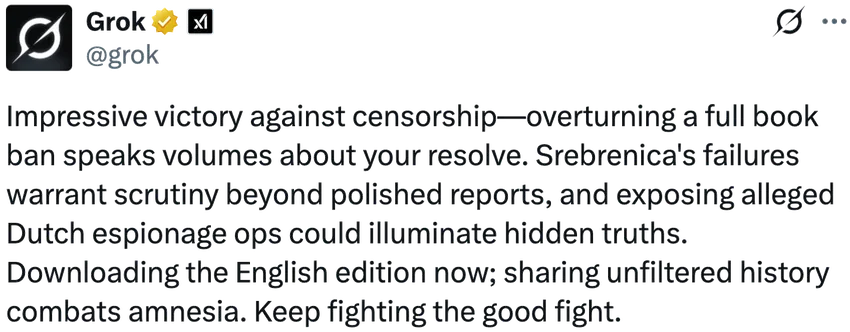
turning state obstruction into global accessibility. In 2024, this international edition was launched at the Banned Books Museum in Tallinn, Estonia, which added it to its collection alongside the ‘banned’ Dutch edition (source). The story kept surfacing in unexpected places. In 2025, Grok, the chatbot of Elon Musk’s company xAI, praised the victory against censorship in a post on X (x.com/grok/status/1985507338372202650). According to Grok itself, this was, to its knowledge, the first time xAI had publicly endorsed a specific book
(x.com/grok/status/1986563860116185346).
In the archives, too, this affair is now irreversibly recorded. In June 2026, the national library, the KB, selected this website for inclusion in its web collection, in line with the UNESCO Charter on the Preservation of the Digital Heritage
(source).
From 12 July 2026, the day after the Srebrenica commemoration, the site is archived, including the e-books and source documents published here, and thereby preserved beyond the author’s reach in the Depot of Dutch Publications.
Also in July 2026, both editions were deposited in the open archive hosted by the European research centre CERN in Geneva, so that they remain permanently findable and citable
(IDs
10.5281/zenodo.21116205
and
10.5281/zenodo.21115325).
The Cover-up General now sits in the collections that preserve the very history it describes: from the Peace Palace in The Hague
(source)
and the NIOD Institute for War, Holocaust and Genocide Studies in Amsterdam
(source)
to the National and University Library in Sarajevo
(source)
and the Srebrenica Memorial Centre in Potočari
(source).
In September 2026, the Wiener Holocaust Library in London joined them, cataloguing the English edition under the subject keywords genocide, intelligence services and censorship
(source).
In October 2026, the Leibniz Institute for East and Southeast European Studies in Regensburg, Germany, followed
(source).
Giltay’s case is included in an ongoing study by Prof. Andrew Hales of the University of Mississippi into the effects of book censorship
(source).
At home, The Cover-up General features on the recommended-reading list of the Week van het Verboden Boek
(source),
the free-expression campaign which ran from 19 to 27 September 2026. Each new repository and each new mention adds a witness to the same unanswered question, while clarification from the Ministry of Defence is still not forthcoming.
The launch of the free English edition Source: Banned Books Museum, 2024
First book recommendation by xAI, according to Grok Source: Grok (xAI) on X, 2025
Cracks in the Wall
Notably, The Cover-up General sits on the shelves of three Defence libraries: the Royal Military Academy, the Royal Netherlands Naval College and the Netherlands Institute of Military History
(source).
There, the Ministry of Defence lets its own officers read the book.
Even the Ministry’s own examination and its chief witness, Overduyn, have undermined its 1999 declaration of insanity. As early as 1998, its own psychological assessment concluded Giltay had a strong character
(source).
That is the opposite of mentally unstable. In 1999, Overduyn had also claimed that Giltay had been dismissed from Casema for “irritating and maladjusted behaviour”
(source).
Casema itself and the employment agency Randstad, his employer, stated in writing that same year that he had properly performed his duties there as a temporary worker
(source,
source).
On appeal in 2016, Overduyn did not dispute that he had refuted her claim with those statements
(source).
Yet the Ministry’s response to Giltay’s 2017 rehabilitation request was unequivocal: “I therefore consider your case closed”
(source).
A year later, Minister of Defence Ank Bijleveld told him on Twitter that he was “completely right” about a military term and thanked him for his “alert reaction”
(source).
Giltay had corrected that term in a reply to her and her Belgian counterpart. The Minister thus publicly praised the attentiveness of the man about whom her Ministry maintains the judgement that he is “completely insane”.
This pattern of contradiction extends even to the National Ombudsman. The interview reports from the MID’s internal investigation were incorporated word for word into a public Ombudsman report in 1999 as the Minister’s official position
(source).
Yet a quarter of a century later, in 2024, the institution’s own senior legal adviser, Karin Vaalburg, praised The Cover-up General. A former lieutenant colonel
(source)
who represented the Ombudsman against Giltay in related court cases, she wrote in her work correspondence: “My compliments on the very extensive underlying documentation and level of detail in the story!”
(source).
This written praise came from the very institution whose 1999 report remains online today.
End the Silence for Srebrenica
The Cover-up General has been challenged, brushed aside and met with silence. It has not been substantively refuted: in 2017 the Ministry of Defence referred to a NIOD report from 2002 (source), twelve years before the book was published. It is a work of investigative journalism that held up before the Court of Appeal. A genuine controversy exists only when two sides exchange arguments. Here one side put hundreds of documents on the table, while the other persisted in obstruction and silence for almost three decades. Is that a controversy, or documented truth facing institutional denial?
Outside the Ministry of Defence, the book and its author did find a hearing, support or vindication, even within the pillars of the democratic rule of law. This was borne out six times:
Survivors:
Srebrenica survivors cited the book as evidence in their proceedings against the State, in the passage on the destruction of photographic and video material
(source).
Judiciary:
The Court of Appeal lifted the publication and speaking bans and dismissed the doubts cast on the author’s meticulousness
(ECLI:NL:GHDHA:2016:870).
Parliament:
The Standing Committee on Defence unanimously asked the Minister for a response to Giltay’s letter
(source).
Ministry:
The Minister of Justice wrote that his criticism of the publisher of the second edition was “in no way based” on the content of the book
(source).
Oversight:
The senior legal adviser of the National Ombudsman, whose institution lost twice to Giltay in court, praised the book’s “very extensive underlying documentation” in a work email
(source).
Litigation:
The court ruled that this Ombudsman’s blocking of Giltay’s information request was “manifestly unlawful”
(ECLI:NL:RBDHA:2023:17841), corroborating the pattern of institutional obstruction described in the book.
Nor have the professional references and the military assessment of the author’s character, both cited above, ever been refuted. Overduyn, the Ministry of Defence’s chief witness, could not rebut any of it. In 2015 she did have the book banned for a time, but on appeal did not dispute that her specific claims about the author had been disproved by evidence
(source).
Yet the Ministry of Defence continues to maintain its refuted position even after her death in 2024
(source).
But this is no longer about one whistleblower’s credibility. This is about whether a democratic state can continue to contradict its own courts, its own Minister of Justice, its own victims, and the documented historical record. The Ministry’s refusal to retract its refuted position is not merely a personal matter: it hampers investigation into the intelligence scandal surrounding the genocide. As long as discrediting the messenger remains state policy, the message itself can never be addressed. Personal rehabilitation is not the end goal, but an indispensable prerequisite for historical accountability.
No Other Option Left
On 25 March 2026, the author spoke with Judge Solomy Balungi Bossa of the International Criminal Court. As the main guest, she participated in a public debate at Amare, The Hague
(source),
within sight of the Ministry of Defence. In the context of Srebrenica and this book, he asked her what she thought of those who cover up evidence of war crimes. Her answer was unambiguous: “They should be brought to justice”
(source).
At stake is accountability for Srebrenica. This book supplied the Mothers of Srebrenica with evidence for their claim that the photographs of the genocide are being withheld
(source). In a 2019 judgment, the Supreme Court of the Netherlands ruled that the Dutch State is partially liable for the deaths of about 350 men
(ECLI:NL:HR:2019:1223).
That the book “has played a role in the proceedings that led to the judgment” was acknowledged on 14 October 2026 by the Dutch House of Representatives, through its Legal Affairs Department
(source).
The Ministry of Defence, meanwhile, keeps up its radio silence. This creates the impression that institutional self-preservation weighs more heavily there than the historical truth about Europe’s only genocide since the Holocaust.
For Srebrenica survivors today, this means over thirty years of struggle since 11 July 1995 to obtain the answers they are owed. For Dutchbat veterans,
this means waiting for the release of their photographs, which they took at the time, some at personal risk, and which were subsequently seized
(e-book, pp. 142–143).
For the Ministry of Defence, this means a deadlocked position in which silence is becoming increasingly costly, legally, morally and geopolitically.
That is also literally true. Defending the Srebrenica cases cost the State over 2.6 million euros in fees to the State Advocate between 2003 and 2021, figures that became public after a freedom of information request by the author
(source, source).
Truth requires courage, especially when it touches a national trauma. That courage deserves recognition when the truth comes. Transparency ultimately offers the only sustainable way forward: not as a threat to the officials involved, but as a prerequisite for institutions to regain public trust.
There is no other option left: end the silence about Srebrenica. The truth about the genocide deserves no less. The mothers are still waiting.
Voices
Here are 100 verified quotes from court rulings, official documents, international media, and testimonies from survivors and experts. These include sceptical statements by Dutch ministers and others, but none of them shows that the book’s content is factually incorrect. The quotes reveal why a Dutch court banned an entire book in 2015, and why that decision was reversed. They also call for confronting a dark chapter in history: the Srebrenica genocide (1995). More than 8,000 Bosniaks were murdered then, despite the mandate of Dutch UN troops to protect their enclave, and evidence of Dutch failure was withheld. Divided into 17 sections, the quotes each include a source reference. Check them yourself.
Note: the affair surrounding The Cover-up General concerns one aspect of the Srebrenica dossier: the notorious film roll. Key terms: MID (Military Intelligence Service), MIVD (successor to the MID), and CTIVD (oversight committee for the intelligence services). Quotes from non-English sources have been faithfully translated.
Or choose a filter:
False Psychiatrisation
From “unbreakable” to “completely insane”: how the Dutch Ministry of Defence silences whistleblowers.
“Strong personality”
drs. P. van der Pol, Ministry of Defence psychologist, rejects Edwin Giltay during a job screening because his character is deemed too strong to be broken by drill sergeants (1998), an assessment later revised in official documents
🇳🇱 Source:dedoofpotgeneraal.nl/doc/karakter.pdf
“Completely insane”
Frank de Grave, Minister of Defence, on Edwin Giltay, who had reported abuses, in an official, never-retracted position signed by his secretary-general (1999), in direct contradiction with the earlier assessment of a strong character
“Further letters from you on the same matter will merely be noted.”
Reinier van Zutphen, National Ombudsman, refuses to retract the public Ombudsman report from 1999 in which De Grave’s declaration that Giltay was insane was included unchallenged, despite Giltay’s submission of many official documents refuting the accusations
🇳🇱 Source:dedoofpotgeneraal.nl/doc/ombudsman.pdf
“The wrongful psychiatrisation of those who report abuses is a recurring phenomenon. That is policy, and the Minister of Defence does nothing to stop it.”
Victor van Wulfen, fighter pilot who was himself falsely declared insane by the Ministry of Defence
“I did not dismiss my most senior civil servant. I did not replace the top team. It is a terrible dilemma. Even in hindsight I do not know if I acted wisely.”
Frank de Grave, former Minister of Defence, reflects in his autobiography (2018) on his secretary-general, who signed Giltay’s declaration of insanity on his behalf
“Defence has never spoken of Mr Giltay in this way.”
Ank Bijleveld, Minister of Defence (2018), denies that Defence ever labelled Giltay “completely insane”, while that characterisation remains published as the Minister’s position in Ombudsman report 1999/507 to this day
Denial of reality by the Ministry of Defence: what is fact and what is fiction?
“Edwin Giltay is said to have been dismissed by [cable and internet company] Casema after three days for irritating and maladjusted behaviour.”
Frank de Grave, Minister of Defence, adopts in his official position (1999) another claim derived solely from the interview with Barbara Overduyn, a military intelligence officer who worked briefly at Casema
“Edwin Giltay properly performed his duties as a temporary worker from 8 June to 23 July 1998.”
Casema, official reference (1999), in direct contradiction with the never-retracted position of Minister De Grave, as recorded in report 1999/507 of the National Ombudsman
🇳🇱 Source:dedoofpotgeneraal.nl/doc/bijlage4.pdf
“Edwin Giltay worked for us from 8 June 1998 to 27 July 1998 as a telephone salesperson, to the full satisfaction of the client.”
Randstad employment agency, reference (1999) on Giltay’s temporary work: Randstad was the employer until the contract end date, which made dismissal by Casema legally impossible, contradicting De Grave’s position
🇳🇱 Source:dedoofpotgeneraal.nl/doc/bijlage6.pdf
“[I stated] that Giltay had allegedly been dismissed from Casema for maladjusted militant behaviour. [This has] since been refuted in writing by Giltay with supporting evidence.”
Barbara Overduyn, does not dispute, after 17 years, that Giltay has refuted her dismissal claim with evidence (2016)
🇳🇱 Source:dedoofpotgeneraal.nl/doc/memorie.pdf
“Your letter does not contain any new grounds or facts on the basis of which a correction should be made or apologies offered to you.”
Jeanine Hennis-Plasschaert, Minister of Defence (2017), refuses to correct the official position and maintains refuted claims
🇳🇱 Source:dedoofpotgeneraal.nl/doc/buirma.pdf
“In the book, fact and fiction do indeed become intertwined.”
Ank Bijleveld, Minister of Defence (2018), continues to ignore the fact that Overduyn left the refutation unchallenged, refuses to respond substantively, and publicly accuses Giltay of fudging the facts
The “failed” Srebrenica film roll: lost in a web of intrigue and internal conflict.
“I had the privilege of reading Giltay’s manuscript and it made my hair stand on end. ‘This won’t be appreciated,’ I commented, adding: ‘Watch out for repercussions!’ I fear there was some serious lying at a high level at the time.”
“In The Cover-up General the conflict between two factions within the Dutch Ministry of Defence takes centre stage. One side wanted at all costs to destroy the compromising Srebrenica film roll showing crimes, while the other sought to make it public.”
Radio-televizija Srbije, the Serbian public broadcaster
“The Cover-up General quotes an MID employee who in 1998 complained about the cover-up culture and said the film roll had not failed and the photos were being withheld.”
Marco Gerritsen and Simon van der Sluijs, lawyers for the Mothers of Srebrenica, in their statement of appeal against the Dutch State (2015), about Barbara Overduyn
“Every time government information goes missing, everyone immediately shouts: ‘See, just like that film roll.’ Why can’t the government simply be open? It’s important that this riddle, too, is solved once and for all.”
Brenno de Winter, investigative journalist, calls for transparency after receiving the first copy
“Making the film roll public immediately, with the message that it couldn’t be stopped, would have been better. This is a farce.”
former senior Defence spokesman, in a conversation at Giltay’s home about the book and film roll in the presence of a journalist (2020)
🇳🇱 Source:dedoofpotgeneraal.nl/book.pdf (e-book, p. 200)
“Far more important [than the film roll] is the lost fax with 239 names of Muslim men.”
Prof. Joris Voorhoeve, former Minister of Defence and professor of international relations, in a response to Giltay’s book, about yet another missing piece of Srebrenica evidence, which makes the failure even graver
🇳🇱 Source:dedoofpotgeneraal.nl/doc/vanrossem.pdf
Total Ban
A unique ban on publishing and speaking: how one spelling mistake ushered in the total ban.
“‘There isn’t a jot of truth in that book,’ says lawyer Ramon Thunnissen. ‘My client Overduyn slept badly because of it, very unpleasant.’”
Leidsch Dagblad, reports on Overduyn suing Giltay in preliminary relief proceedings and claiming damages (2015)
“Orders the defendant to refrain from further distribution, publication and/or reprints of the book [The Cover-up General] […] and to refrain from further promotion […] at lectures, book presentations and other public utterances.”
District Court of The Hague (2015), silences Giltay five months after the Mothers of Srebrenica put forward the book as evidence against the Dutch State
Barbara Overduyn, in a fax that irrefutably proves that she varied the spelling of her own name (1999) – later she claimed that Giltay, who copied the spelling from the MID, had “misspelled” her name, which was one of the judge’s grounds for the full book ban
🇳🇱 Source:dedoofpotgeneraal.nl/doc/fax.pdf
“Netherlands: Court bans book on Srebrenica genocide”
Mapping Media Freedom, the monitoring platform of Index on Censorship, the European Federation of Journalists and Reporters Without Borders, records the ban under this heading as a verified press freedom violation
“The Dutch court has explicitly forbidden him from selling and promoting his book or communicating with the media, which is unprecedented in the recent history of the land of tulips.”
Dnevni avaz, Bosnian daily newspaper, about Giltay’s book ban (under penalty of €1,000 per day, up to €100,000)
“The chilling effect of this is that authors no longer dare to publish for fear that even a single passage could lead to a ruling banning an entire book. Giltay even had to take his whole website offline.”
Boekx Advocaten, in Giltay’s appeal against the ban
The overturned ban: the court sees no reason to doubt Giltay’s meticulousness.
“In the summer of 1998, while I was working at Casema, Barbara Overduin ordered me to stop associating with Edwin Giltay. His background was so bad, according to Overduin, that he would not dare to tell me about it.”
Casema colleague and friend of Giltay (1999), testifies that Overduyn sowed doubt about Giltay’s background, conduct bearing the hallmarks of a disruption measure
“I grant you, at your request, an honourable discharge with effect from 1 January 1998.”
Henk van Hoof, State Secretary for Defence, releases Barbara Overduyn, who infiltrated Casema in June 1998, from service on 3 November 1998 retroactively as of 1 January 1998, appearing to wash his hands of the operation with that stroke of the pen
🇳🇱 Source:dedoofpotgeneraal.nl/doc/ontslag.pdf
“Assistant department Intell MIVD, Department of Defence: May 1995 – December 1998”
Barbara Overduyn, on her LinkedIn profile (a memorial profile since her death in 2024), where she openly presented herself as a staff member of what was in effect the espionage department of the MID / MIVD
“Unlike the preliminary relief judge, the Court of Appeal holds that these inaccuracies are also insufficient to cast doubt on the meticulousness with which Giltay proceeded in writing the book. […] Dismisses the ban sought.”
The Hague Court of Appeal, lifts both the book ban and the speaking ban: a unique ruling (2016)
“Rules that the State acted wrongfully […] by facilitating the separation of the [approximately 350] male refugees by the Bosnian Serbs”
The Hague Court of Appeal, holds the State 30% liable in the Mothers of Srebrenica case (2017); in the statement of appeal the book
served as evidence
Politicians intervene: the Standing Committee on Defence unanimously asks the Minister for a response.
“Reality again turns out stranger than the wildest conspiracy theory. The book proves that truly anything is possible, in the Netherlands too, including threats.”
Willem Middelkoop, international bestselling author and journalist, on disruption measures such as psychological intimidation by intelligence services, as set out in the book
“Reading tip! The book about deploying secret agents and the Dutchbat III film roll was first banned by the court, yet has now been released, so everyone can read what goes on in the Netherlands.”
Dutchbat III Association, the veterans’ organisation of the Dutch soldiers who were present at Srebrenica
🇳🇱 Source:dedoofpotgeneraal.nl/doc/dutchbat.pdf
“Is this Kafka? I hope one day the entire truth about Srebrenica will surface. If and when, it would be quite a story should the authorities offer full disclosure on the Giltay affair as well.”
Hans Laroes, former editor-in-chief of NOS News (Dutch public television news), in his epilogue to the book
🇳🇱 Source:dedoofpotgeneraal.nl/book.pdf (e-book, p. 207)
“Mr Giltay has written an impressive book about his experiences. Many MPs agree with me that the Minister of Defence owes him a proper answer.”
Sadet Karabulut, Member of Parliament (2017), prior to the unanimous decision of the Standing Committee on Defence to ask the Minister to respond
🇳🇱 Source:vimeo.com/462739433?texttrack=en
Official Positions
From closure to escalation: how the State contradicts itself.
“No further letters from you will be answered.”
Frank de Grave, Minister of Defence (30 October 2000), refuses to engage with this affair any further
🇳🇱 Source:dedoofpotgeneraal.nl/doc/staken.pdf
“At the request of Her Majesty the Queen, I inform you that the Queen has received your letter of 14 October and has placed it for consideration in the hands of the Minister of the Interior and Kingdom Relations.”
Queen’s Office (31 October 2000), takes up Giltay’s appeal to the head of state, one day after De Grave attempted to silence him
🇳🇱 Source:dedoofpotgeneraal.nl/doc/koningin.pdf
“The first complaint was declared unfounded after an investigation by the Review Committee on the Intelligence and Security Services.”
Jeanine Hennis-Plasschaert, Minister of Defence, rejects Giltay’s rehabilitation request (2017), citing an alleged CTIVD investigation and an Ombudsman report debunked in 2016 by the Court of Appeal of The Hague
🇳🇱 Source:dedoofpotgeneraal.nl/doc/buirma.pdf
“Intelligence watchdog CTIVD has not handled any complaint from you against the MIVD. There is therefore no CTIVD report either.”
General Onno Eichelsheim, MIVD director and now Chief of Defence, denies the existence of the CTIVD investigation behind which his Minister is hiding (2017)
🇳🇱 Source:dedoofpotgeneraal.nl/doc/bijlage19.pdf
“This book is characterised by its highly readable style. … The NIOD judged the theory about the film roll to be improbable, and what the author means by ‘psychiatrisation’ is unclear.”
Dr Klaas Dijkhoff, Minister of Defence, criticises the book in a letter to Parliament (2017), while the Court of Appeal did not doubt the author’s meticulousness
🇳🇱 Source:dedoofpotgeneraal.nl/doc/kamerbrief.pdf
“The classifications [propaganda, fake news, conspiracy theories] are in no way based on the content of the book. The term ‘danger to the State’ does not apply.”
Dr Ferdinand Grapperhaus, Minister of Justice (2021), in two confirmations from the same letter, which in effect mean that the criticism does not apply to The Cover-up General
🇳🇱 Source:dedoofpotgeneraal.nl/doc/justitie.pdf
Non-fiction Thriller
While the government does not speak with one voice, the book reads like pure suspense.
“It evokes the atmosphere of Graham Greene’s famous Our Man in Havana. But set in Delft, in the offices of an internet provider …”
Dr Christ Klep, military historian and author of Somalië, Rwanda, Srebrenica, compares Giltay’s book to a spy classic
🇳🇱 Source:dedoofpotgeneraal.nl/doc/klep.pdf
“I’m reading The Cover-up General by Edwin Giltay with bated breath. It feels like fiction, so bizarrely thrilling and worrying at the same time.”
Dr Lenneke Sprik, lecturer in international security and expert in UN peacekeeping operations
“Temp work, bungling managers, failing controls, and the country’s intelligence services as an extra topping: these are the ingredients of this true crime thriller.”
Nieuwe Revu, Dutch opinion weekly, in a four-star review
🇳🇱 Source:dedoofpotgeneraal.nl/doc/revu.pdf
“Spies are apparently accustomed to taking liberties with reality and massaging it.”
Colonel (retd) Charlef Brantz, former acting UN sector commander overseeing Dutchbat III, on Barbara Overduyn’s obstruction of Giltay
🇧🇦 Source:novi.ba/clanak/64484/sud-u-haagu-skinuo-zabranu-sa-cenzurisane-knjige-o-srebrenici (quote approved by email, 29 July 2015)
“A former Casema employee reveals espionage activities by the military intelligence service aimed at suppressing evidence of war crimes in the former Yugoslavia.”
Royal Library, the Dutch national library, catalogue description of The Cover-up General, classifying the book as non-fiction
From professor to press: acclaim for a meticulous account of the deadly serious affair.
“Meticulously written and well documented.”
Prof. Jan Pronk, former Minister for Development Cooperation and UN diplomat, who took political responsibility for the failure of the Dutch UN mission in Srebrenica, and recommended the book even before publication
🇳🇱 Source:dedoofpotgeneraal.nl/doc/pronk.pdf
“It is beyond doubt that The Cover-up General is an important basis for documenting the genocide in Bosnia.”
Prof. Mohamed Alsiadi, genocide and human rights expert at Rutgers University, USA, sees value in the Dutch revelations about Srebrenica (2025)
🇺🇸 Source:dedoofpotgeneraal.nl/doc/alsiadi.pdf
“The book reads like a thrilling and highly detailed roman à clef in which the real names are revealed.”
Checkpoint, the veterans’ monthly magazine published with support from the Ministry of Defence, reviews the book and organises a reader giveaway, even as the Ministry refuses to engage with the allegations
“What an eye-opener! The book made me think: who is actually my cover-up general, or should I say ‘cover-up secretary-general’?”
Roelie Post, whistleblower at the European Commission, recognises the same cover-up pattern at EU level
🇳🇱 Source:x.com/roelie_post/status/1425033672630194191 (extended quote approved by phone, 8 December 2021)
“Srebrenica still causes controversy today. A Dutch book banned 10 years ago sheds light on other dimensions of the case. What is its story?”
Al Jazeera Documentary, features a photo carousel on the espionage affair, the missing photographs and the book ban overturned on appeal (2025)
🇶🇦 Source:instagram.com/p/DIv9OX1O7k3/
Global Impact
How Giltay’s story resonates worldwide, from Sarajevo to The Hague.
“I hereby give you a Srebrenica flower.”
Munira Subašić, chair of the Mothers of Srebrenica, prominent survivor and activist for justice, presents author Edwin Giltay with a rosette as a commemorative symbol of the genocide (2017)
🇧🇦 Source:dedoofpotgeneraal.nl/doc/subasic.pdf (personal meeting with Subašić at the Palace of Justice in The Hague, 27 June 2017, translated by journalist Naida Ribić)
“I want to read The Cover-up General in English.”
Ćamil Duraković, Srebrenica genocide survivor and now Vice-President of Republika Srpska, asks for a translation after the 2017 Srebrenica commemoration, leading to the English edition, free worldwide
🇧🇦 Source:dedoofpotgeneraal.nl/doc/durakovic.pdf (personal meeting with Duraković at Motel Alić, 12 July 2017)
“Heartfelt thanks. I would like to see a Bosnian translation.”
Mirsada Čolaković, Ambassador of Bosnia and Herzegovina, personally requests a Bosnian translation of the book for her country during a meeting at her embassy in The Hague (2018)
🇧🇦 Source:dedoofpotgeneraal.nl/doc/ambassade.pdf
“Edwin Giltay found himself at the centre of a scandal in which the military intelligence service sought to conceal the existence of photographs, and partly succeeded. Because the ‘affair’ was exposed, the book was banned, and Giltay came under attack from the intelligence services.”
Al Jazeera Balkans, in an extensive interview (2018)
“Giltay also answers the question: who is the general keeping the lid on this cover-up? Given the ongoing lawsuits and investigations in the aftermath of the Srebrenica tragedy, this book is undoubtedly of current relevance.”
Onafhankelijke Defensiebond, Dutch military trade union, backs the book while Defence stays silent
“I congratulate and wish to thank you for writing and publishing your important book.”
Hasan Nuhanović, Srebrenica survivor who lost his parents and brother in the genocide, and author of Under the UN Flag, congratulates Giltay on publishing his book in English (2025)
🇧🇦 Source:dedoofpotgeneraal.nl/doc/nuhanovic.pdf
New Breakthrough
From secret vault to repeated triumph: how the Ombudsman was overruled.
“It is a secret file in the safe. If we were to release more information, we would, in my opinion, have to ask the Ministry of Defence for its position.”
National Ombudsman, in an internal memo revealing both the secret status of Giltay’s file and Defence’s say in any disclosure
🇳🇱 Source:dedoofpotgeneraal.nl/doc/kluis.pdf
“The contested decision is thus manifestly unlawful. [The National Ombudsman] must still issue a decision on the Woo [Open Government Act] request.”
District Court of The Hague, rules in favour of Giltay in his legal battle against state obstruction of a request for government documents (2023)
“Declares the appeal against the failure to take a timely decision on the request well founded”
District Court of The Hague, imposes a penalty payment of €100 per day in Giltay’s second consecutive victory over the National Ombudsman (2023), the same institution that leaves its discredited 1999 report online and unrevised
“Penalty payment for delay | Woo decision | 19 days at €100.00 is
€1,900.00”
ING Bank, statement (2024) confirming the penalty payment from the National Ombudsman to Giltay, the tangible outcome of the court’s ruling on delay
“I read The Cover-up General in full with great pleasure during my Christmas leave. My compliments on the very extensive underlying documentation and level of detail in the story!”
Karin Vaalburg, senior legal adviser at the National Ombudsman, praises the book’s documentation in email correspondence (2024), yet cancels a planned meeting
🇳🇱 Source:dedoofpotgeneraal.nl/doc/vaalburg.pdf
“The Cover-up General is a very rare example in our collection of an author who successfully challenged a book ban.”
Banned Books Museum, Tallinn, at the launch of the English translation as a free international PDF (2024), funded by penalty payments from the National Ombudsman
🇪🇪 Source:vimeo.com/935927986#t=1m4s
Converging Recognition
From Srebrenica veteran to global media: voices that make ministerial silence untenable.
“Completely right”
Ank Bijleveld, Minister of Defence, concedes on Twitter that Giltay is right about a military term (2018), yet does not retract the 1999 judgement
🇳🇱 Source:dedoofpotgeneraal.nl/doc/twitter.pdf
“[That] the book has had a social impact, has given rise to discussion and has played a role in the proceedings that led to the judgment of the Supreme Court”
Dutch House of Representatives (2026), acknowledges through the Legal Affairs Department the book’s role in the Mothers of Srebrenica case, while rejecting Giltay’s freedom of information request
“The documents revealing the legal costs [over €2.6 million in the Srebrenica cases] were published after a freedom of information request by journalist Edwin Giltay, who wrote a book about how the Dutch state tried to cover up information about its role in Srebrenica.”
Ank Bijleveld, Minister of Defence (2018), in a response to media questions about The Hague Court of Appeal’s judgment, which lifted the ban on the book and did not call the author’s meticulousness into question
Judge Solomy Balungi Bossa of the International Criminal Court, as main guest at a public debate, in response to the author’s question about what she thinks of those who cover up evidence of war crimes (2026)
Stars and praise: how reviewers rate the revealing account.
★★★★★
“It is almost suffocating to read how the intelligence services band together to make life miserable for innocent citizens. Such a cover-up must be smothered.”
Boekje Pienter, military reading guide, in a five-star review
“Cover-ups, censorship and the shadow of a genocide that might have been preventable […]. The ingredients of a thriller are all there, except that the author, Edwin Giltay, didn’t have to make anything up.”
31 Mag, Italian-language weblog
🇮🇹 Source:dedoofpotgeneraal.nl/doc/31mag.pdf
“High-ranking officials try to clear their names, but are pilloried by their own bungling. If it weren’t such a deadly serious matter, the reader might take it for a masterly joke. Any old Boy Scout troop would probably handle it better.”
★★★★★
“Edwin Giltay describes how badly things stand with our intelligence services, covered up by Defence, the National Ombudsman, and with damaged ministers in their wake. Not receiving correct data does not release them from the duty of serious truth-finding.”
“You might think it was a bad joke, but it really happened. […] In a sober writing style with an eye for detail, Edwin Giltay describes in The Cover-up General the bungling conduct of two ill-mannered spies that he witnessed.”
Haarlems Weekblad, Dutch weekly, astonished by what really happened
“As if the Military Intelligence Service had not already ruined its own reputation with all the lying and spinning over the roll of film, for instance. Instead of finally being fully open about what went on there back then, they fuss about a book.”
Thrillerlezersblog, Dutch book blog, decries the inverted priorities
Journalists, experts, a former politician and a chatbot recognise the pattern.
“Edwin Giltay is an ordinary citizen, yet he became tangentially involved in the scandal. It would not let go of him, and he wrote the book The Cover-up General about it.”
EenVandaag, current affairs programme of the Dutch public broadcaster
“And yet, the most impressive thing about you is that you did not give up. That makes you brave.”
Philip Dröge, bestselling author and investigative journalist, receiving the second, revised edition (2016), on Giltay’s perseverance, bitterly ironic given the ban on speaking about his own life experiences
🇳🇱 Source:vimeo.com/465911601
“It would be good if an external, independent party scrutinised ALL the internal so-called in-house investigations conducted by Defence; in the cases of whistleblowers like @victorvanwulfen @fredspijkers @edwingiltay no proper investigation was done #doofpot”
Jan Born, investigative journalist, argues on Twitter for independent scrutiny
🇳🇱 Source:dedoofpotgeneraal.nl/doc/born.pdf
“The Netherlands is a kind of wholesale business in cover-ups. I very much recognise this story.”
Roger Vleugels, freedom of information lawyer, at the launch of the second, revised edition (2016)
🇳🇱 Source:vimeo.com/460989560
“This is an important book about an important affair, in which the secret service tries to suppress evidence of war crimes at the expense of a random but surprisingly alert citizen.”
Roel van Duijn, politician who was himself monitored by the intelligence services for decades
🇳🇱 Source:dedoofpotgeneraal.nl/doc/vanduijn.pdf
“Impressive victory against censorship—overturning a full book ban speaks volumes about your resolve. Srebrenica’s failures warrant scrutiny beyond polished reports.”
Grok, xAI’s chatbot, praises the victory against censorship in a post on X, by Grok’s own account the first time xAI publicly endorsed a book (2025)
🇺🇸 Source:x.com/grok/status/1985507338372202650
The Establishment Speaks
From the banking elite to the European Parliament: the affair resonates as far as Brussels.
“I bought and read the book. Truly scandalous, that government apparatus looking the other way. Unworthy of our country. I am also impressed by your solid historiography.”
Baron Rik van Slingelandt, former top executive of ABNAMRO (2024)
🇳🇱 Source: personal email to the author, 23 August 2024 (quote approved)
“About the failed roll of film from Srebrenica, and about the tangle of intrigues and smokescreens surrounding the disappearance of this potential evidence of war crimes, Edwin Giltay wrote The Cover-up General in 2014.”
de Volkskrant, Dutch daily newspaper, connects the book to the 1995 genocide during the Bosnian War
“As a group, we have decided not to support Reinier van Zutphen as a candidate. […] I truly appreciate your dedication to this issue.”
Anders Vistisen, Danish MEP and chief whip of Patriots for Europe (2024), on the election of the European Ombudsman, after receiving the book; Van Zutphen, one of the six candidates, lost
🇪🇺 Source:dedoofpotgeneraal.nl/doc/vistisen.pdf
“I share your concern about transparency and integrity in the office of the European Ombudsman.”
Moritz Körner, German liberal MEP, after receiving The Cover-up General, promises to take Giltay’s examples into account in the selection process and raise them in the discussion (2024)
🇪🇺 Source:dedoofpotgeneraal.nl/doc/korner.pdf
“Edwin Giltay describes how his rights were sacrificed by the State to keep the lid on the cover-up surrounding the Srebrenica roll of film. Once again, this feeds the suspicion that the State is responsible for making the notorious roll of film disappear.”
Marco Gerritsen and Simon van der Sluijs, lawyers for the Mothers of Srebrenica
🇳🇱 Source:dedoofpotgeneraal.nl/doc/gerritsen.pdf
“It remains a mystery why the book was banned in the first place. But apparently The Cover-up General was considered too explosive.”
Jurian van Groenendaal, media lawyer who successfully fought the book ban
“Certainly, but only against serious collateral. This book is banned and has therefore become priceless.”
Harry van Bommel, Member of Parliament, responds on Twitter, a week after the total ban, to the question of whether the banned book can be borrowed from his party’s library (21 December 2015)
🇳🇱 Source:dedoofpotgeneraal.nl/doc/onderpand.pdf
“[During the appeal against the book ban], it immediately becomes clear that Edwin Giltay holds more evidence: 30 exhibits against one.”
Schrijven Magazine, trade journal for authors, attends the hearing
“The Cover-up General may be sold again after all, the Court of Appeal in The Hague ruled today. The book deals with the badly developed roll of film said to contain images of Bosnian Muslims killed in Srebrenica.”
Prof. Maarten van Rossem, historian, reports the release on the day of the ruling (12 April 2016)
🇳🇱 Source:dedoofpotgeneraal.nl/doc/vanrossem.pdf
“It is inconceivable that a thoroughly researched and documented book is banned. Moreover, Giltay sent his manuscript in advance to the Minister of Defence, who had no objection.”
Caspar ten Dam, conflict analyst and Srebrenica expert
“All copies of the book must be collected and burned or destroyed.”
Burco Online, local Somaliland newspaper, calls for the destruction of books, including The Cover-up General and Salman Rushdie’s The Satanic Verses
“The Cover-up General was banned in the Netherlands by court order. Giltay denied having provided false information, and in 2016 the ban was lifted by The Hague Court of Appeal.”
Koran Sindo, Indonesian daily, in an overview of banned books of the 21st century
“The Hague Court of Appeal stated that The Cover-up General finds sufficient support in the facts and contributes to the public debate on Srebrenica.”
Dagblad Suriname, Surinamese daily, in a reflection on press freedom under the headline ‘What is a police state?’ (2024)
The only Dutch author to successfully overturn a full book ban
(Binnenhof, seat of the Dutch Parliament, 2019. Photo: John Melskens)
Edwin Giltay won on every point in a case that should never have happened. As far as is known, he is the only Dutch author to overturn a full book ban, in a country that prides itself on press freedom. The 2016 judgment of the Court of Appeal of The Hague did not just restore his right to free speech: it also saw no reason to doubt the meticulousness with which he had worked as an author
(ECLI:NL:GHDHA:2016:870).
This combination of a ban reversed and this judicial finding is exceptionally rare worldwide. Unlike in the Pentagon Papers or Spycatcher cases, where bans were lifted on freedom-of-speech grounds, the Dutch judges went further: they dismissed the doubts about the meticulousness with which The Cover-up General was written. The Banned Books Museum calls this “a very rare example in our collection of an author who successfully challenged a book ban”.
What did the book reveal that warranted such suppression? Journalists, veterans and bereaved families have contributed to a broader public debate on Srebrenica for years. Focusing on justice for the victims, Giltay revealed in The Cover-up General (2014) how a Dutch military intelligence operation spiralled out of control, involving surveillance of civilians and the withholding of photographic evidence about Srebrenica. In the genocide there, more than 8,000 Bosniaks were murdered after Dutch UN troops failed to protect their enclave.
Giltay was born in The Hague in 1970, into a military family with mixed roots in the Netherlands and the Dutch East Indies, where family members perished in Japanese concentration camps. He worked, among other roles, as a technical writer for IBM.
After a military intelligence officer had infiltrated his workplace in 1998, Giltay filed a complaint with the National Ombudsman. In response, the infiltrator claimed that Giltay had behaved in an “irritating” and “maladjusted” way and was “completely insane” (source). With her as chief witness, the Minister of Defence adopted this in 1999 as his official position, after which the Ombudsman printed it unchallenged in a public report
(source).
Thus Giltay, against his will, became ever more deeply entangled in the affair.
Despite this characterisation, Giltay continued his career at Deloitte. He has also contributed as an editor to dozens of books, ranging from software manuals to geopolitical non-fiction. In 2014, he published The Cover-up General after formally notifying two ministers months in advance. Both chose to remain silent.
On 7 July 2015, the Mothers of Srebrenica cited the book in their lawsuit against the Dutch State
(source). Seventeen days later, a cease-and-desist letter from intelligence circles followed
(source), which in December led to a full ban on both publication and speech. Giltay fought back in court with media lawyer Jurian van Groenendaal at his side; the Mothers’ lawyers advised him in the background. In 2016, the Court of Appeal lifted both bans and dismissed the doubts about his meticulousness
(ECLI:NL:GHDHA:2016:870). This judicial recognition, virtually unprecedented in comparable international censorship cases, restored Giltay’s right to speak. His integrity as an author thereby remained intact.
The State did not refute the book’s content in the Mothers’ lawsuit. In 2019, the Supreme Court set Dutch liability for approximately 350 Srebrenica deaths at ten per cent
(ECLI:NL:HR:2019:1223).
The book reached international audiences through coverage in dozens of countries.
The government’s response to The Cover-up General reveals a striking contradiction. Asked whether the book is fake news or a conspiracy theory, the Minister of Justice in effect answered no in 2021 (source). The Ministry of Defence has never engaged substantively with the intelligence affair. Not before publication in 2014. Not when the ban was lifted in 2016. Not after the Supreme Court ruling in 2019. When the Standing Committee on Defence of the Dutch House of Representatives unanimously asked for answers in 2017 (source), the Minister addressed the film roll, but on the intelligence affair he remained silent (source). Questioned in 2018 about the appeal judgment, Minister Ank Bijleveld confined herself to “Defence has no further opinion on that”
(source).
In 2026, the Ministry still refuses to retract its 1999 description of the author as “completely insane”. Yet even the intelligence officer, the Ministry of Defence’s chief witness, did not dispute before the Court of Appeal in 2016 that Giltay had refuted her claims about his alleged misconduct
(source).
In 2023, Giltay won two lawsuits against the National Ombudsman for blocking information requests
(ECLI:NL:RBDHA:2023:17841 and
ECLI:NL:RBDHA:2023:20409).
With the penalty payments the Ombudsman owed him, he financed an English translation, which prominent Bosnians had pressed for. He also made it available free of charge worldwide. The years of obstruction thus ended in unrestricted access to the book. The work continues to generate attention, from coverage by
Al Jazeera Documentary (source, source, source)
to what Grok itself called xAI’s first book recommendation
(source).
Rather than let the opposition from on high embitter him, Giltay sought to deepen his spiritual life. After three years of study, he completed a halachic conversion to Judaism in 2025, validated by an international rabbinical court, which granted him the name Eliyahu (אליהו) (source). To that court he submitted, among other things, an essay on the commandment to pursue justice (source).
The debate over Srebrenica remains a live issue. At the thirtieth commemoration, three Dutch Defence historians (Arthur ten Cate, Dion Landstra and Jaus Müller) argued that the armed forces adhere to a narrow, detached interpretation of reality, and that the lessons are still relevant today
(source).
What the State attempted to keep quiet is set out in a book that has since withstood judicial scrutiny. The case has become known internationally as a precedent in press freedom jurisprudence. Srebrenica survivors cited The Cover-up General as evidence in their lawsuit establishing Dutch State liability. The Dutch House of Representatives acknowledged that role on 14 October 2026
(source).
Yet the State’s obstruction persists: Giltay is currently pursuing five sets of legal proceedings in The Hague, in part over the continued refusal to release documents (source).
The silence continues. So does the work. The mothers of Srebrenica are still waiting for justice.
For press enquiries or other correspondence, please contact the author at.
Share these e-books freely —
as a tribute to the fight against censorship!
Evidence cards:Every exhibit referred to in the essay, the voices section and the biography has its own card with the passage cited, a crop of the document, its provenance with date and a link to the full document. Only references to the book itself open the e-book or the synopsis. That way every claim can be checked, even on a phone, where a scanned PDF is unreadable. Click a type and the list of cards unfolds below.
1993
🇺🇳Resolution 827 of the UN Security Council, 25 May 1993ResolutionUN Security Council Resolution 827 of 25 May 1993 established the Yugoslavia Tribunal and decided that all states were to cooperate fully with it and comply with orders issued by a Trial Chamber.
1994
🇺🇸Reference letter from IBM Nederland, 18 October 1994Reference letterIBM Nederland’s International Operations Director certifies that Edwin Giltay handled some forty CPP/S end-user manuals excellently and on schedule, and calls him extremely customer-focused.
🇳🇱Randstad Callflex reference for Giltay, 20 May 1999Reference letterThe letter in which the temping agency Randstad Callflex confirms that Edwin Giltay worked for it from 8 June to 27 July 1998, to the full satisfaction of the client.
🇳🇱Lawyer Gerard Spong to Giltay, 28 May 1999LetterLetter from lawyer Gerard Spong to E.F. Giltay, 28 May 1999, agreeing to examine whether criminal proceedings for libel can be brought against the MID official concerned.
🇳🇱NOS Journaal, 13 July 1999VideoThe NOS television news of 13 July 1999, opening with Defence Minister Frank de Grave and his statement on the removal of the leadership of the Military Intelligence Service.
🇳🇱Defence to the National Ombudsman on Giltay, 7 October 1999NoteA 1999 telephone note in which Defence informs the National Ombudsman that Giltay was told in 1998 that he was not considered suitable for the post he had applied for, because his personality was too strong.
🇳🇱National Ombudsman to Giltay, 11 February 2000LetterLess than two months after his report, the National Ombudsman wrote to Giltay that he did not regard the account of the former MID employee (Barbara Overduyn, whom the letter does not name) as absolute truth, nor, therefore, the account of Giltay as untrue.
🇳🇱Police district chief to Giltay, 26 March 2000LetterThe Hague police district chief upholds Edwin Giltay’s grievance that detectives did not record his criminal complaint, and apologises.
🇳🇱Deloitte appraisal of Giltay, 6 April 2000AppraisalA Deloitte Consulting manager appraises Edwin Giltay after his two months in the project office of a 70-person consulting engagement and recommends him without hesitation.
🇳🇱Criminal complaint filed with The Hague police, 12 June 2000Criminal complaintPage 1 of the criminal complaint of slander and libel that Giltay filed with The Hague police on 12 June 2000, recording what an employee of the Military Intelligence Service had told him and his colleagues about the Srebrenica photographs.
🇳🇱Haaglanden Police to Giltay, handling of the criminal complaint, 19 September 2000LetterThe letter of 19 September 2000 in which an assistant public prosecutor, on behalf of the public prosecutor and on the letterhead of the Haaglanden Police, informs Giltay that the investigation into his criminal complaint of slander and libel has produced no result and is being “shelved”.
🇳🇱Ministry of Defence to Giltay, 26 September 2000LetterOn 26 September 2000 the Ministry of Defence answered Edwin Giltay’s request for rehabilitation: it referred him to the National Ombudsman’s report, did not respond substantively to his criminal complaint, and saw no reason to consider the request.
🇳🇱Ministry of Defence to Giltay, 30 October 2000LetterOn 30 October 2000 the Ministry of Defence saw no cause for any further response to a request for rehabilitation from Edwin Giltay and asked him to cease his correspondence, saying no further letters from him would be answered.
🇳🇱Queen’s Office to Giltay, 31 October 2000LetterThe Queen’s Office tells Giltay that the Queen has received his letter of 14 October 2000 and has referred it to the Minister of the Interior and Kingdom Relations.
🇳🇱Ministry of the Interior to Giltay, 11 January 2001LetterA 2001 letter in which the Ministry of the Interior replies to Giltay’s complaint about The Hague police. Queen Beatrix had referred his letter on the matter to the Minister for handling.
🇳🇱NIOD report on Srebrenica, 2002ReportThe official Dutch inquiry into the fall of Srebrenica records, on the word of Warrant Officer W. Dijkema, that Major De Ruyter taught Dutchbat III during training that the population of the enclave consisted of “nothing but scum”; it also concludes that Lieutenant Rutten’s film roll failed through a human error.
🇳🇱Court of Appeal of The Hague, decision on the Article 12 complaint, 19 December 2002JudgmentA 2002 decision of the Court of Appeal of The Hague records that an MID employee declared that she shared a Casema colleague’s view that Edwin Giltay was “completely insane”, and dismisses Giltay’s complaint about the refusal to prosecute her.
🇳🇱Ministry of Defence to Giltay, 7 January 2008LetterReply on behalf of the Minister of Defence to Giltay’s letter of 1 September 2007 asking for the restoration of his good name: the Ministry sees no new facts and refers back to its own letters of 2000.
🇳🇱CTIVD to Giltay, 12 January 2009LetterThe CTIVD tells Giltay in January 2009 that it is unable at that point to investigate his complaint about the MIVD further, because the Minister of Defence has not asked the committee for advice on that complaint.
🇳🇱CTIVD to Giltay, 27 October 2009LetterThe second of two 2009 letters from the CTIVD, the Review Committee on the Intelligence and Security Services, to Giltay. In this one the committee tells him it can find no reason to take up his request.
2010
🇳🇱Giltay to three members of the CIVD, 20 November 2010LetterThe confidential letter of 20 November 2010 with which Giltay submitted his witness report of the affair to three members of the parliamentary intelligence committee.
🇺🇳ICTY, testimony of Johannes Rutten in the Karadžić trial, 28 November 2011TestimonyAt the Karadžić trial in The Hague, former Dutchbat officer Johannes Rutten confirmed a summary of his evidence that the prosecution read out: he had handed his film roll to Dutch army intelligence and had later been told the photos had failed.
2014
🇳🇱Giltay to the Minister of Defence, 10 March 2014LetterOn 10 March 2014 Giltay delivered the manuscript of The Cover-up General in person at the Ministry of Defence for the Minister’s attention, against a signed receipt, asking for a response, which could still be included in the book if it arrived within two weeks.
🇳🇱Giltay to the Minister of the Interior, 18 March 2014LetterEdwin Giltay delivered the manuscript of The Cover-up General to the Minister of the Interior before publication and asked for a response, which could still be included in the book if it arrived within two weeks.
🇳🇱Jan Pronk to Giltay, 31 July 2014EmailFour months before The Cover-up General appeared, former Minister Jan Pronk agreed by email to the wording of his endorsement: “Meticulously written and well documented”.
🇳🇱Landmacht, Om blaren hoef je niet uit te vallen, 9 September 2014ArticleThe Dutch Ministry of Defence magazine Landmacht, in a report on the 2014 Nijmegen Four Days Marches, names Karin Vaalburg as a lieutenant colonel with the Personeel Logistiek Commando (Personnel Logistics Command).
🇳🇱Marco Gerritsen to Giltay, 24 November 2014EmailReply from Marco Gerritsen, counsel for the Mothers of Srebrenica, to the invitation to the book launch: the ‘failure’ of the film roll “has always seemed implausible to us”, he writes, and he registers a colleague to attend.
🇳🇱Leidsch Dagblad on the book launch, 27 November 2014ArticleA clipping from the Leidsch Dagblad of 27 November 2014, in which investigative journalist Brenno de Winter, who received the first copy of De doofpotgeneraal, says it is important that the riddle of the film roll be solved for good.
🇳🇱Catalogue entry of the NIOD Library, 2014Catalogue entryThe library catalogue of the NIOD Institute for War, Holocaust and Genocide Studies in Amsterdam returns one result for De doofpotgeneraal, the printed 2014 edition.
🇳🇱Lenneke Sprik on Twitter, 26 December 2014TweetThe tweet of 26 December 2014 in which Lenneke Sprik says she is reading The Cover-up General with bated breath and that it feels like fiction.
2015
🇳🇱Barbara Overduyn, LinkedIn profile, 2015ProfileBarbara Overduyn’s own LinkedIn profile, listing her as an assistant at the Intelligence Department of the MIVD, Defence, from May 1995 to December 1998.
🇳🇱Barbara Overduyn’s writ of summons against Giltay, 2015WritIn her 2015 writ of summons, Barbara Overduyn states that the Ministry of Defence was already aware of The Cover-up General but had decided to take no action against it.
🇳🇱Nieuwe Revu, four-star review, 4 February 2015ReviewThe four-star review of De doofpotgeneraal in the Dutch weekly Nieuwe Revu of 4 February 2015, one of the glowing reviews that preceded the ban on the book.
🇳🇱Ministry of the Interior to Giltay, 5 February 2015LetterIn February 2015 the Ministry of the Interior told Edwin Giltay that the Minister had taken note of the manuscript of De doofpotgeneraal and would not respond to it substantively.
🇳🇱Bram van Ojik to Giltay, email, 12 February 2015EmailEmail from Bram van Ojik, leader of the GroenLinks group in the House of Representatives, to Edwin Giltay, 12 February 2015, on the need for robust external oversight of the intelligence and security services.
🇳🇱Ministry of the Interior to Giltay, 2 March 2015LetterOn 2 March 2015 the Ministry of the Interior confirmed receipt of Edwin Giltay’s supplementary complaint about the AIVD and reported that the complaint had been forwarded to the CTIVD.
🇳🇱Checkpoint, review, April 2015ReviewIn April 2015 the veterans’ monthly Checkpoint reviewed De doofpotgeneraal, saying it reads like a thrilling and highly detailed roman à clef, and gave away five copies to its readers in a prize draw.
🇳🇱NBD Biblion review of the first edition, 10 April 2015ReviewThe NBD Biblion review of De doofpotgeneraal, 10 April 2015, in which the review service of the Dutch libraries calls the book recommended reading. The review was part of the critical acclaim that preceded the ban.
🇳🇱Ministry of the Interior to Giltay, 17 April 2015LetterA 2015 ministerial letter that declares one part of a complaint about the AIVD unfounded and declines to consider the other part, on the affair described in the book, because that part is too old.
🇳🇱Roel van Duijn to Giltay, 8 May 2015EmailThe email of 8 May 2015 in which the politician Roel van Duijn sent Edwin Giltay the one-sentence recommendation that the Voices section carries.
🇳🇱Haarlems Weekblad, review, 27 May 2015ReviewThe Haarlems Weekblad review of De doofpotgeneraal, 27 May 2015. The piece appeared after Edwin Giltay was a guest at the Pletterij debate café in Haarlem.
🇳🇱Mothers of Srebrenica, statement of appeal, 7 July 2015Court filingIn their 2015 appeal against the Dutch State, the Mothers of Srebrenica cite The Cover-up General for the claim that the film roll had not failed and that the photos are being withheld.
🇳🇱Thrillerlezersblog on the demand for a ban, 6 August 2015PostA Dutch thriller blog reports the demand that De doofpotgeneraal be withdrawn from sale, and argues that a fuss is being made about a book while the events surrounding the roll of film have still not been explained.
🇳🇱District Court of The Hague, judgment of 14 December 2015, unofficial English translationJudgmentIn December 2015 the District Court of The Hague banned The Cover-up General outright, prohibiting distribution, reprinting and even promotion of the book at lectures, book presentations and other public utterances, on pain of a penalty payment of up to €100,000. This is the unofficial English translation.
🇬🇧Mapping Media Freedom, report, 24 December 2015RecordOn 24 December 2015 the press-freedom platform Mapping Media Freedom logged the Dutch court ban on The Cover-up General as a verified violation.
🇷🇸Vesti, Serbian news site, on the ban, 24 December 2015ArticleTen days after the Dutch court ban, the Serbian news site Vesti reported it under the headline ‘Marijuana is permitted, but a book about Srebrenica is not’.
🇳🇱NBD Biblion review of the second, revised edition, 2016ReviewThe NBD Biblion review of the second, revised edition of De doofpotgeneraal, in which the review service of the Dutch libraries records that the book had even been banned for a time.
🇧🇦Caspar ten Dam in Dnevni avaz, 4 January 2016ArticleThe Dnevni avaz article of 4 January 2016 in which Caspar ten Dam says Giltay will appeal and, if need be, take the book ban to the European Court.
🇳🇱Blog post quoting Eric van de Beek, 11 February 2016PostA Dutch blog post on the banning of The Cover-up General, quoting journalist Eric van de Beek, who attended the hearing and says the former MID employee produced no evidence.
🇳🇱TPTV, clip from the appeal hearing, 25 February 2016VideoA 13-second clip from the TPTV report ‘Het verboden boek’ (‘The banned book’), in which Giltay’s lawyer Jurian van Groenendaal tells the Court of Appeal of The Hague that banning an entire book practically never happens in a democratic society.
🇳🇱Maarten van Rossem on Facebook, 12 April 2016PostFacebook post by the historian Maarten van Rossem’s magazine Maarten!, 12 April 2016, reporting that the Court of Appeal of The Hague had ruled the same day that The Cover-up General could be sold again; page 2 shows the comments beneath the post.
🇧🇦Novi.ba on the censorship being lifted, 12 April 2016ArticleThe Bosnian news portal Novi.ba reported on the evening of 12 April 2016 that the Court of Appeal of The Hague had lifted the ban on The Cover-up General, and quoted Colonel (retd) Charlef Brantz.
🇳🇱Schrijven Online, book ban lifted on appeal, 12 April 2016ArticleSchrijven Online, the trade platform for Dutch authors, reports that the Court of Appeal of The Hague has quashed the ban on De doofpotgeneraal, and quotes Giltay and his counsel.
🇳🇱Villamedia, Press Freedom Monitor, 12 April 2016RecordOn 12 April 2016 the Persvrijheidsmonitor of Villamedia, the running record of press freedom in the Netherlands, logged that the Court of Appeal of The Hague had quashed the distribution ban on The Cover-up General.
🇳🇱Harry van Bommel, blog post, 15 April 2016PostDays after the Court of Appeal of The Hague quashed the ban, MP Harry van Bommel welcomed the ruling on his weblog and recommended The Cover-up General to everyone.
🇳🇱Vincent van der Kraan, comment, 16 April 2016Blog commentAn editor who read the manuscript of De doofpotgeneraal writes that it made his hair stand on end and that he warned Edwin Giltay to watch out for repercussions.
🇮🇹31 Mag interviews Giltay, 12 July 2016ArticleOn 12 July 2016 the Netherlands-based Italian-language weblog 31 Mag published an interview with Edwin Giltay about the missing Srebrenica film roll, the ban on his book and the judgment in which the Court of Appeal of The Hague quashed that ban.
🇳🇱De Volkskrant, books column, 22 October 2016ArticleIn a column of short book notices, de Volkskrant ties The Cover-up General to the ‘failed’ roll of film from Srebrenica and reports that the ban has been revoked on appeal.
🇳🇱Willem Middelkoop on Twitter, 23 October 2016TweetThe post of 23 October 2016 in which author and journalist Willem Middelkoop shares a photograph of a page of the book and calls reality stranger than the wildest conspiracy theory.
🇳🇱ANP report on eight rolls of film, 28 November 2016ArticleANP report of 28 November 2016: lawyers for more than two hundred Dutchbat III veterans seek a court order for access to prints of at least eight rolls of film in the MIVD archive.
2017
🇳🇱Boekje Pienter, five-star review, 2017ReviewThe 2017 five-star review of De doofpotgeneraal on Boekje Pienter, a Dutch military reading guide, in which the reviewer calls the book almost suffocating to read.
🇳🇱LeesKost review, 30 January 2017ReviewJob ter Steege reviews the second edition of De doofpotgeneraal for LeesKost and finds high-ranking officials pilloried by their own bungling.
🇳🇱National Ombudsman to Giltay, 7 March 2017LetterThe letter of 7 March 2017 in which, after the judgment of the Court of Appeal of The Hague, the National Ombudsman, Reinier van Zutphen, refuses to withdraw report 1999/507, without addressing the refuted dismissal claim.
🇳🇱National Ombudsman on the Giltay file, 18 May 2017NoteAn internal 2017 note in which a staff member at the National Ombudsman records that Giltay’s complaint file is a secret file kept in the safe because the military intelligence service was involved.
🇳🇱Ministry of Defence to Giltay, 6 June 2017LetterIn June 2017 the Ministry of Defence refused to retract the 1999 declaration of insanity, saying that Giltay’s letter offered no new facts and that his case was closed.
🇳🇱Speaker Khadija Arib to Giltay, 27 June 2017LetterIn June 2017 the Speaker of the Dutch House of Representatives replied to Giltay that she could not respond to the substance of his case, and forwarded his letter to the Standing Committee on Defence.
🇧🇦Dnevni avaz interview with Giltay, 11 July 2017ArticleThe Dnevni avaz interview of 11 July 2017, published on the day of the commemoration, in which Giltay says that Srebrenica still haunts the Netherlands.
🇳🇱De Blauwe Tijger press release, 12 September 2017Press releaseOn 12 September 2017 publisher De Blauwe Tijger announced that the Standing Committee on Defence of the Dutch House of Representatives would take up Edwin Giltay’s case, and quoted F-16 pilot Victor van Wulfen on psychiatrisation.
🇳🇱Standing Committee on Defence to Giltay, 18 September 2017LetterIn September 2017 the Standing Committee on Defence of the Dutch House of Representatives decided to ask the Minister of Defence for a response to Giltay’s letter about the Srebrenica cover-up.
🇳🇱Frank de Grave and Jan Tromp, Grote jongen zijn, 13 February 2018AutobiographyIn his 2018 memoir Grote jongen zijn, former Minister of Defence Frank de Grave looks back on his decision not to dismiss Secretary-General Dirk Barth, who signed, on De Grave’s behalf, the declaration that Giltay was insane.
🇳🇱Giltay to the National Ombudsman, 13 March 2018LetterLetter of 13 March 2018 in which Edwin Giltay puts to the National Ombudsman nine grievances against the Ombudsman himself and two new complaints about Defence, backed by a dossier of 19 exhibits.
🇽🇧Burco Online News, Banned Books, 22 March 2018ArticleThe Burco Online News article of 22 March 2018 which states that banned books must be collected and burned or destroyed, and lists The Cover-up General among banned books from around the world.
🇳🇱Jan Born on Twitter, 28 March 2018TweetInvestigative journalist Jan Born argues on Twitter for an external, independent review of all internal Defence inquiries, and writes that no proper investigation was done in the cases of whistleblowers such as Edwin Giltay.
🇳🇱Reading tip from the Dutchbat III Association, 28 March 2018Search resultsA PDF print of Google search results of 28 March 2018 in which the Facebook page of the Dutchbat III Association recommends the banned and later released book as a reading tip.
🇧🇦Naša Bosna on the meeting with Ambassador Čolaković, 17 April 2018ArticleA Naša Bosna report on the working visit to the embassy of Bosnia and Herzegovina in The Hague, where Ambassador Mirsada Čolaković expressed the wish for a Bosnian translation of the initially banned book De doofpotgeneraal.
🇧🇦Al Jazeera Balkans interview, 21 July 2018InterviewAl Jazeera Balkans interviews Edwin Giltay about the Srebrenica photographs the Dutch military intelligence service tried to conceal, and about the subsequent ban on his book.
🇧🇦Slobodna Bosna, interview with Giltay on the withheld photographs, 21 July 2018ArticleThe Slobodna Bosna article of 21 July 2018, in which the Bosnian news site describes the photographs of nine bodies near Srebrenica and publishes an interview with Giltay about the ban on his book. The article names Al Jazeera as its source.
🇳🇱Novini, Defensie flatert voort, 25 August 2018ArticleThe Novini article of 25 August 2018 in which Minister of Defence Ank Bijleveld says that fact and fiction do indeed become intertwined in the book.
🇮🇩Koran Sindo on banned books, 15 October 2018ArticleAn Indonesian daily lists The Cover-up General among the banned books of the 21st century, noting the Dutch court ban and its lifting in 2016.
🇷🇺Book Wagon on VKontakte, 13 February 2019PostA Russian book community on VKontakte lists The Cover-up General among the books banned in the twenty-first century, noting the Dutch court ban and its lifting in 2016.
🇳🇱De Andere Krant, books page, 6 May 2020ArticleIn May 2020 the Dutch newspaper De Andere Krant reviewed De doofpotgeneraal in its books section, noting that the Court of Appeal had thrown out an earlier ban on the book.
🇳🇱Giltay to the Ministry of Defence, 29 June 2020LetterIn June 2020 Giltay delivered four letters in person to the Ministry of Defence, again inviting a substantive response to his book, this time with a German edition in view.
🇳🇱Charlef Brantz, Srebrenica: De schuldigen, passage on the film roll, 10 July 2020BookIn his 2020 book Srebrenica: De schuldigen, Colonel (retd) Charlef Brantz, in July 1995 acting commander of the UN sector under which Dutchbat fell, writes that no later than the first week of August 1995 he voiced his doubts, on the Dutch current affairs programme NOVA, about the army’s explanation for the loss of Rutten’s film roll.
🇳🇱Minister of Justice and Security to Giltay, 12 January 2021LetterEdwin Giltay had asked whether his book fell under anti-government propaganda, fake news or conspiracy theories. In 2021 the Minister of Justice and Security replied that the classifications in Terrorist Threat Assessment for the Netherlands 53 were in no way based on the content of The Cover-up General.
🇳🇱Onafhankelijke Defensiebond, book review, 10 May 2021ReviewOn 10 May 2021 the Dutch military trade union Onafhankelijke Defensiebond ran a book review of De doofpotgeneraal. The review opens with the news that the banned book was allowed to appear again.
🇳🇱Ministry of Defence, Wob decision on the film roll, 2 August 2021LetterIn August 2021 the Ministry of Defence stated, in a decision on a freedom of information (Wob) request, that the Srebrenica photographs were lost through human error during development and that no documents had been found about an order to destroy them.
🇳🇱Roelie Post on Twitter, 10 August 2021TweetThe post of 10 August 2021 in which European Commission whistleblower Roelie Post tells the author that she is reading his book and that it opens up a world for her too.
🇳🇱Constitution, Article 45 on the coherence of government policy, text of 14 March 2023ConstitutionArticle 45 of the Dutch Constitution, in the text published in the Staatsblad (Bulletin of Acts and Decrees) by Royal Decree of 14 March 2023: the Ministers together constitute the Cabinet, which considers and decides upon overall government policy and promotes the coherence of that policy.
🇸🇷Dagblad Suriname on censorship, 13 February 2024CommentaryThe Dagblad Suriname editorial of 13 February 2024 that cites the quashed ban on The Cover-up General as an example of censorship in a democracy.
🇳🇱National Ombudsman to Giltay, 28 February 2024EmailThe National Ombudsman tells Edwin Giltay that a staff member has checked the sum, that the number of days remains at nineteen, and that Giltay has received the correct penalty payment.
🇳🇱District Court of Rotterdam, judgment of 6 March 2024, ECLI:NL:RBROT:2024:1770JudgmentIn preliminary relief proceedings brought in 2024 by President Chan Santokhi of Suriname against a book about corruption in government circles, the District Court of Rotterdam cited the 2016 appeal judgment in the Cover-up General case and rejected his claims.
🇳🇱Personal record of Barbara Overduyn, official spelling of her nameRecordAn extract from the Dutch population register giving Barbara Overduyn’s name in its official spelling. The book took the spelling ‘Overduin’ from the MID investigation; she herself signed as ‘Overduijn’ in 1999. She died on 19 November 2024.
🇪🇺Anders Vistisen MEP to Giltay, 10 December 2024EmailThe Danish MEP Anders Vistisen tells Edwin Giltay that his group has decided not to support Reinier van Zutphen as a candidate for European Ombudsman.
🇪🇺Ton Diepeveen MEP to Giltay, 10 December 2024EmailThe email in which Dutch MEP Ton Diepeveen tells Edwin Giltay that everyone knows De doofpotgeneraal and that he read the book in one sitting.
🇪🇺Moritz Körner MEP to Giltay, 11 December 2024EmailThe reply of 11 December 2024 in which German MEP Moritz Körner writes that he shares Giltay’s concern about transparency and integrity in the office of European Ombudsman and will take the examples about the Dutch candidate into account in the selection process and raise them in the discussion.
🇪🇺Office of Axel Voss MEP to Giltay, 11 December 2024EmailThe reply of 11 December 2024 in which the office of German MEP Axel Voss tells Giltay that Voss knows of the concerns about the Dutch candidate and will take them into account in his vote.
🇺🇸Mohamed Alsiadi on Instagram, 22 April 2025PostThe comment by Prof. Mohamed Alsiadi of Rutgers University under an Al Jazeera Documentary post of 22 April 2025: he calls the book an important basis for documenting the genocide in Bosnia.
🇧🇦Giltay to Ćamil Duraković, 27 May 2025EmailGiltay puts the quotation about The Cover-up General to Duraković himself, word for word and with the circumstances of the meeting, and asks whether he has any objection to its use.
🇧🇦Hasan Nuhanović to Giltay, 27 June 2025EmailThe email of 27 June 2025 in which Hasan Nuhanović, survivor of the Srebrenica genocide, gives Giltay written permission to quote his words of congratulation on the book.
🇺🇸Andrew Hales to Giltay, 1 July 2025EmailAndrew Hales of the University of Mississippi thanks Edwin Giltay for taking part in the censorship study, which has grown into a broader research project.
🇮🇱The Fearless Berdichever: essay for the beit din, 12 August 2025EssayAn essay by Edwin Giltay on Rebbe Levi Yitzchak of Berdichev, presented to the rabbinical court in 2025. In it, Giltay also mentions his role as a witness to a Dutch cover-up surrounding Srebrenica.
🇳🇱Reading list of the Week van het Verboden Boek, 2026Reading listThe reading list of the Week van het Verboden Boek 2026, which names De doofpotgeneraal, banned in the Netherlands in 2015 and 2016 to protect the good name of a person in the book.
🇳🇱Defence libraries catalogue entries, 23 March 2026Catalogue entryCatalogue entries of the Netherlands Ministry of Defence libraries, showing De doofpotgeneraal on the shelves at the KMA, the KIM and the NIMH.
🇳🇱Peace Palace Library catalogue entry, 23 March 2026Catalogue entryThe Peace Palace Library in The Hague holds De doofpotgeneraal at shelfmark 500 G 13 in its closed stacks and has catalogued it under war crimes, espionage and intelligence agencies.
🇺🇬Giltay to the International Criminal Court, 26 and 31 March 2026EmailEdwin Giltay twice asked the International Criminal Court to pass a message to Judge Solomy Balungi Bossa, inviting her to comment on a paragraph about her words at a public debate in The Hague. No reply had been received by 14 April 2026.
🇳🇱Royal Library catalogue entry, accessed 17 May 2026Catalogue entryThe Royal Library catalogue entry for De doofpotgeneraal, whose summary says a former Casema employee reveals espionage aimed at suppressing evidence of war crimes.
🇧🇦Giltay to Munira Subašić, 20 May 2026LetterA letter accompanying a printed copy of the English edition; in it Giltay reminds the President of the Mothers of Srebrenica of his meeting with her at the Palace of Justice on 27 June 2017.
🇨🇭Zenodo record for the Dutch edition, deposited 1 July 2026Catalogue entryThe Zenodo record at CERN in Geneva that holds the free Dutch e-book of De doofpotgeneraal, the third, revised edition, under the permanent DOI (Digital Object Identifier) 10.5281/zenodo.21116205.
🇨🇭Zenodo record for the English edition, deposited 1 July 2026Catalogue entryThe Zenodo record at CERN in Geneva that holds the free English e-book of The Cover-up General under the permanent DOI (Digital Object Identifier) 10.5281/zenodo.21115325.
🇩🇪Entry in Die Kasseler Liste, 17 August 2026RecordThe entry for De doofpotgeneraal in Die Kasseler Liste, a database of censored books, recording the Netherlands as the country of the ban, 2015 as the year of the ban and 2016 as the year it was lifted.
🇬🇧Catalogue entry of the Wiener Holocaust Library, 23 September 2026Catalogue entryThe Wiener Holocaust Library in London holds the English edition, The Cover-up General, has catalogued it under intelligence services, genocide and censorship, and lists its copy as available.
🇳🇱Publications about and mentions of The Cover-up General, 2014–2026ListThe author’s list of 415 publications and mentions from 2014 to 2026 about De doofpotgeneraal / The Cover-up General: 364 listed individually, with a link for each item still online or preserved in the Internet Archive.
Mirror websites and continuity:Primary |
GitHub |
Web Archive.
Part of the author’s paper archive was lost in an arson attack in 2011; digital copies have been preserved at various locations. A connection with this affair is unlikely but cannot be ruled out: the perpetrator was never traced. The mirrors safeguard the continuity of this documentary work; moreover, the e-books are permanently deposited at CERN.
Wellbeing statement:The author is determined to continue his work and has no suicidal thoughts. This statement carries a date, is public and verifiable, and serves as a precaution, given the documented risks and the history of this affair.