Exhibit · Commentary
Dagblad Suriname on censorship, 13 February 2024
The passage
“The book De doofpotgeneraal by Edwin Giltay was placed under a distribution ban in 2015 because a former employee of the Military Intelligence Service claimed she had been described in it incorrectly. On appeal this ban was quashed. The Hague Court of Appeal stated that the book finds sufficient support in the facts and contributes to the public debate on Srebrenica.” The paragraph on censorship in democratic countries; the ban on the book is the third of the three cases the paper lists there. Translated from the Dutch; the original wording is below. De doofpotgeneraal is the book’s original Dutch title; the English edition is The Cover-up General.
Original wording
“Het boek De doofpotgeneraal van Edwin Giltay kreeg in 2015 een verspreidingsverbod opgelegd omdat een voormalige medewerkster van de Militaire Inlichtingendienst claimde dat ze er onjuist in was beschreven. In hoger beroep werd dit verbod vernietigd. Het Gerechtshof Den Haag gaf aan dat het boek voldoende steun vindt in de feiten en een bijdrage levert aan het maatschappelijk debat over Srebrenica.” Quoted from the editorial as published on dbsuriname.com. These are the last three sentences of that paragraph; the sentences before them concern the two Belgian cases. The paper carries the passage without quotation marks of its own.
Why this document matters
In this editorial of 13 February 2024 on police states, censorship and self-censorship, Dagblad Suriname, a Surinamese daily, sets the 2015 distribution ban on the book beside two Belgian cases as examples showing that books can be banned in a democracy too. It reports that the ban was quashed on appeal and that the Court of Appeal of The Hague stated that the book finds sufficient support in the facts and contributes to the public debate on Srebrenica. The judgment itself says that the book’s description of the former employee “at least partly finds support in the facts” (para. 4.10) and that the inaccuracies are insufficient to call the author’s meticulousness into question (para. 4.9). The paper adds that in this case freedom of expression must outweigh the right of the former employee (Barbara Overduyn, whom the paper does not name) to protection of her honour and reputation.
The editorial opens by noting that the terms police state and censorship have become more relevant “above all with the unprecedented actions surrounding the publication of a book by a businessman based in the Netherlands”. The paper names no one. Eight days later, the District Court of Rotterdam heard the preliminary relief proceedings that President Chan Santokhi had brought against the Netherlands-based writer and the publisher of a book about corruption in government circles. In its judgment of 6 March 2024, the court cited the 2016 appeal judgment in the Cover-up General case and rejected Santokhi’s claims. The essay counts this piece as part of the international coverage around the launch of The Cover-up General abroad in 2024.
Provenance
- Document
- Editorial on the Dagblad Suriname website, retrieved from the live site
- Publication
- Dagblad Suriname, Surinamese daily newspaper, dbsuriname.com
- Section
- Redactioneel, the paper’s editorial column
- Headline
- ‘Wat is een politiestaat?’ (‘What is a police state?’)
- Author
- No byline, published as an editorial
- Date
- 13 February 2024, 04:30 Suriname time according to the page’s own metadata, 08:30 Dutch time; the page also carries a second date as the time of last modification: 12 February 2024, 21:18 Suriname time (13 February, 01:18 Dutch time)
- Subject
- The character of a police state, censorship and self-censorship, including the question whether books may be kept from readers in a democracy
- References
- Herman Brusselmans’s Uitgeverij Guggenheimer, banned in Belgium in 1999; the withdrawal of an issue of the magazine Humo in 2008; and the 2015 distribution ban on De doofpotgeneraal, quashed on appeal
- Language
- Dutch
- Web address
- dbsuriname.
com/ 2024/ 02/ 13/ wat-is-een-politiestaat/ - Archived copy
- Wayback Machine, 27 September 2026
- See also
- Court of Appeal of The Hague, judgment of 12 April 2016, ECLI:NL:GHDHA:2016:870District Court of Rotterdam, judgment of 6 March 2024, ECLI:NL:RBROT:2024:1770
Cited in:
- the essay ‘The Ban Fell, the Book Stood’ in the chapter (5) ‘More Than a Banned Book’
- the Voices section under the heading ‘Across Borders’.
Document: https://
Archived copy: https://
Accessed 15 November 2026.
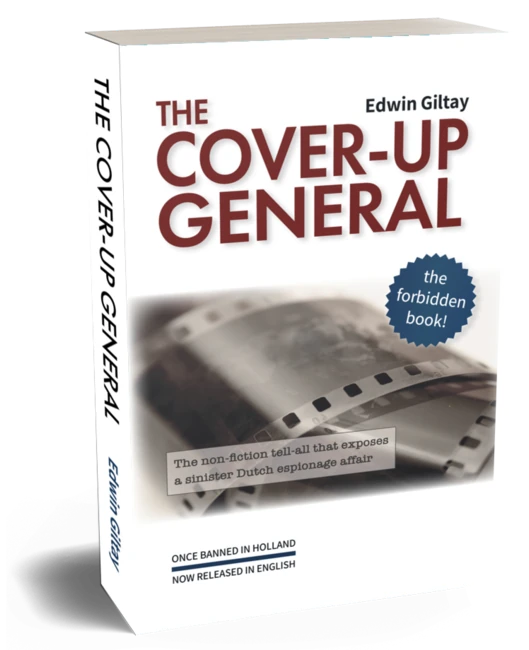
This page is an exhibit to the book The Cover-up General by Edwin Giltay and its accompanying website.