Exhibit · Judgment
Court of Appeal of The Hague, judgment of 12 April 2016, ECLI:NL:GHDHA:2016:870
The essay cites this judgment in nine places, covering five different paragraphs, and the author biography cites it in two; the Voices section also quotes the operative part. The passages are set out below in the order of the judgment, each with its own link and an extract from the page itself. The quotations are taken from the certified copy, which names the parties. The version published on deeplink.
Para. 2.5 · The manuscript went to both ministers before publication
“Before publishing the book, Giltay sent the manuscript to the Minister of Defence and the Minister of the Interior, with the request that they respond to it.” Page 2 of the certified copy. Established as fact by the Court of Appeal and not in dispute between the parties. Translated from the Dutch; the original wording is below.
“Giltay heeft alvorens het boek te publiceren het manuscript gezonden naar de Minister van Defensie en de Minister van Binnenlandse Zaken, met het verzoek hierop te reageren.” Original wording

Para. 3.1 · What was demanded: a declaration in three daily newspapers that what he wrote about her was complete fiction
“an order that Giltay, at his own expense, place a rectification in three national newspapers, reading: ‘In my book De Doofpotgeneraal I have wrongly ascribed a major role to Barbara Overduyn. Everything I have written in that regard is incorrect. It is not non-fiction, but complete fiction, which I ought not to have published (or caused to be published) without her consent’” Page 3 of the certified copy, the first of three claims at first instance. The preliminary relief judge refused it, and no appeal was brought against that refusal (para. 4.1). Translated from the Dutch; the original wording is below. De doofpotgeneraal is the book’s original Dutch title; the English edition is The Cover-up General.
“Giltay te veroordelen om in drie landelijke dagbladen voor zijn rekening een rectificatie te plaatsen, die luidt: “In mijn boek De Doofpotgeneraal heb ik Barbara Overduyn een majeure rol toegedicht. Het is allemaal onjuist wat ik daaromtrent heb geschreven. Het is geen non-fictie, maar volstrekte fictie die ik zonder haar toestemming niet had mogen (doen) publiceren”” Original wording

Para. 4.5 · The claim about the roll of film may be the subject of a debate of public interest
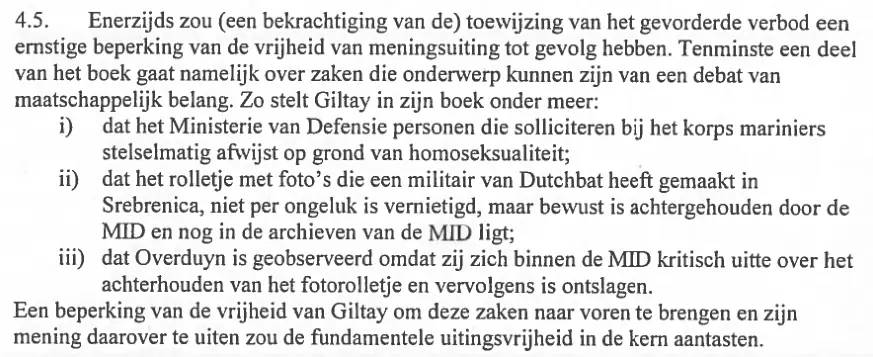
“At least part of the book, after all, concerns matters that can be the subject of a debate of public interest. Thus Giltay states in his book, among other things: i) that the Ministry of Defence systematically rejects persons applying to the marine corps on the ground of homosexuality; ii) that the roll of film with photographs that a soldier of Dutchbat took in Srebrenica was not destroyed by accident, but was deliberately withheld by the MID and is still in the MID’s archives; iii) that Overduyn was placed under observation because she expressed herself critically within the MID about the withholding of the roll of film, and was subsequently dismissed. A restriction of Giltay’s freedom to raise these matters and to express his opinion on them would impair the fundamental freedom of expression at its core.” Page 5 of the certified copy. The court did not establish that the claims are true; it held that raising them falls under the freedom of expression. Translated from the Dutch; the original wording is below.
“Tenminste een deel van het boek gaat namelijk over zaken die onderwerp kunnen zijn van een debat van maatschappelijk belang. Zo stelt Giltay in zijn boek onder meer: i) dat het Ministerie van Defensie personen die solliciteren bij het korps mariniers stelselmatig afwijst op grond van homoseksualiteit; ii) dat het rolletje met foto’s die een militair van Dutchbat heeft gemaakt in Srebrenica, niet per ongeluk is vernietigd, maar bewust is achtergehouden door de MID en nog in de archieven van de MID ligt; iii) dat Overduyn is geobserveerd omdat zij zich binnen de MID kritisch uitte over het achterhouden van het fotorolletje en vervolgens is ontslagen. Een beperking van de vrijheid van Giltay om deze zaken naar voren te brengen en zijn mening daarover te uiten zou de fundamentele uitingsvrijheid in de kern aantasten.” Original wording
Para. 4.9 · The inaccuracies are insufficient to cast doubt on the author’s meticulousness
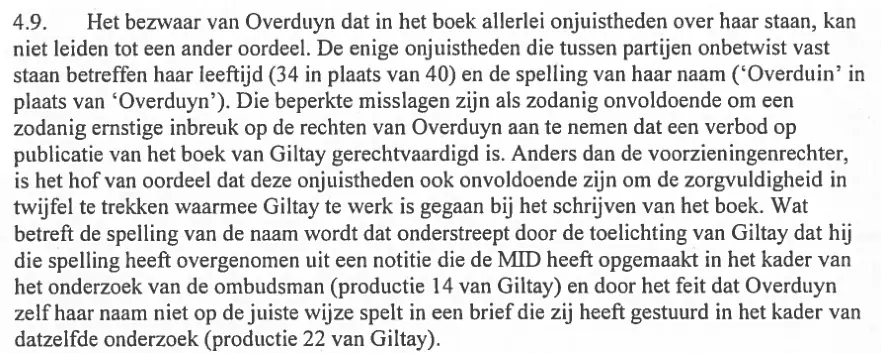
“Overduyn’s objection that the book contains all kinds of inaccuracies about her cannot lead to a different judgment. The only inaccuracies that are undisputed between the parties concern her age (34 instead of 40) and the spelling of her name (‘Overduin’ instead of ‘Overduyn’). Those limited errors are, as such, insufficient for assuming so serious an infringement of Overduyn’s rights that a ban on publication of Giltay’s book is justified. Unlike the preliminary relief judge, the Court of Appeal holds that these inaccuracies are also insufficient to cast doubt on the meticulousness with which Giltay proceeded in writing the book. As regards the spelling of the name, this is underlined by Giltay’s explanation that he adopted that spelling from a note drawn up by the MID in the context of the Ombudsman’s investigation (Giltay’s exhibit 14) and by the fact that Overduyn herself does not spell her name in the correct manner in a letter she sent in the context of that same investigation (Giltay’s exhibit 22).”
Page 6 of the certified copy. The version published on deeplink.
“Het bezwaar van Overduyn dat in het boek allerlei onjuistheden over haar staan, kan niet leiden tot een ander oordeel. De enige onjuistheden die tussen partijen onbetwist vast staan betreffen haar leeftijd (34 in plaats van 40) en de spelling van haar naam (‘Overduin’ in plaats van ‘Overduyn’). Die beperkte misslagen zijn als zodanig onvoldoende om een zodanig ernstige inbreuk op de rechten van Overduyn aan te nemen dat een verbod op publicatie van het boek van Giltay gerechtvaardigd is. Anders dan de voorzieningenrechter, is het hof van oordeel dat deze onjuistheden ook onvoldoende zijn om de zorgvuldigheid in twijfel te trekken waarmee Giltay te werk is gegaan bij het schrijven van het boek. Wat betreft de spelling van de naam wordt dat onderstreept door de toelichting van Giltay dat hij die spelling heeft overgenomen uit een notitie die de MID heeft opgemaakt in het kader van het onderzoek van de ombudsman (productie 14 van Giltay) en door het feit dat Overduyn zelf haar naam niet op de juiste wijze spelt in een brief die zij heeft gestuurd in het kader van datzelfde onderzoek (productie 22 van Giltay).” Original wording
Para. 4.10 · The role is not “purely invented” or “complete fiction”
“What is established, however, is that the role Overduyn plays in the book, contrary to what she suggests, is not ‘purely invented’ or ‘complete fiction’.” Page 6 of the certified copy. Here the court refutes Overduyn’s suggestion that her role is complete fiction. The same claim appeared in the rectification she sought at first instance (para. 3.1). Para. 4.10 then lists the facts on which the description of her role rests, at least in part. Translated from the Dutch; the original wording is below.
“Vast staat echter wel dat de rol die Overduyn in het boek speelt, anders dan zij suggereert, niet ‘puur verzonnen’ of ‘volstrekte fictie’ is.” Original wording

Decision 5.1.1 · The ban sought is dismissed
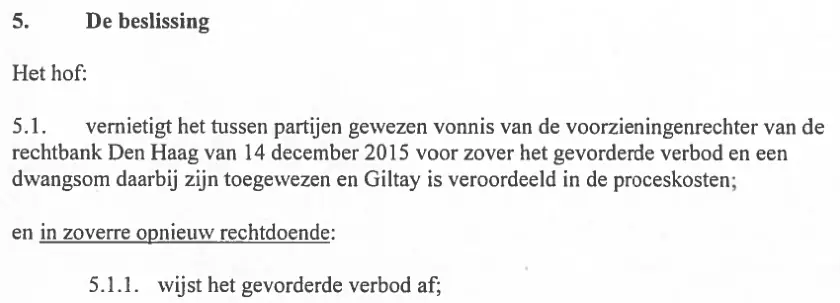
“The Court of Appeal: 5.1 sets aside the judgment of 14 December 2015 rendered between the parties by the preliminary relief judge of the District Court of The Hague, in so far as the ban sought and a penalty payment attached to it were granted and Giltay was ordered to pay the costs of the proceedings; and, to that extent adjudicating anew: 5.1.1 dismisses the ban sought;” Page 7 of the certified copy, under the heading ‘De beslissing’ (‘the decision’). The rest of the operative part deals with the costs and otherwise affirms the first-instance judgment, which had already refused the rectification and the advance on damages. Translated from the Dutch; the original wording is below.
“Het hof: 5.1. vernietigt het tussen partijen gewezen vonnis van de voorzieningenrechter van de rechtbank Den Haag van 14 december 2015 voor zover het gevorderde verbod en een dwangsom daarbij zijn toegewezen en Giltay is veroordeeld in de proceskosten; en in zoverre opnieuw rechtdoende: 5.1.1. wijst het gevorderde verbod af;” Original wording
Why this document matters
On 12 April 2016 the Court of Appeal of The Hague quashed both the full ban on The Cover-up General and the speaking ban on its author. In para. 4.9 it held that the only two undisputed inaccuracies, an age and the spelling of a name, were also insufficient to cast doubt on the meticulousness with which the author had proceeded in writing the book.
The claimant, a former employee of the military intelligence service MID, had also demanded that Giltay declare in three national newspapers that what he had written about her was complete fiction. The court established that her role in the book is not “purely invented” or “complete fiction”, and dismissed the ban sought.
Provenance
- Document
- Judgment on appeal (arrest) in preliminary relief proceedings
- Court
- Court of Appeal of The Hague, Civil Law Division
- Date
- 12 April 2016, delivered in open court
- Case number
- 200.183.987/01
- District Court case number
- C/09/497903 / KG ZA 15/1556
- Case-law identifier
- ECLI:NL:GHDHA:2016:870
- Parties
- The appellant, the author, versus the respondent, a former employee of the military intelligence service MID
- Counsel
- J.G.J. van Groenendaal, Amsterdam, for the appellant; R.F. Thunnissen, The Hague, for the respondent
- Bench
- P.H. Blok, G. Dulek-Schermers and H.J.M. Burg
- Subject
- Media law; ban sought on a reprint of the book De doofpotgeneraal; weighing freedom of expression against the right to respect for private life
- Judgment appealed
- Preliminary relief judge of the District Court of The Hague, 14 December 2015
- References
- Paras 2.5, 3.1, 4.5, 4.9 and 4.10; operative part in 5.1.1
- Language
- Dutch; unofficial English translation: dedoofpotgeneraal.
nl/ doc/ arrest-en.pdf - Published in
- Rechtspraak.nl, ECLI:NL:GHDHA:2016:870, in anonymised form; NJF 2016/242; RAV 2016/75; IR 2016/92
- Held by
- Author’s archive (copy); the anonymised version with the Council for the Judiciary (Raad voor de rechtspraak), deeplink.
rechtspraak. nl/ uitspraak? id= ECLI: NL: GHDHA: 2016: 870 - See also
- Barbara Overduyn’s writ of summons against Giltay, 2015District Court of The Hague, judgment of 14 December 2015, ECLI:NL:RBDHA:2015:15050
Cited in:
- the essay ‘The Ban Fell, the Book Stood’ in the chapters (1) ‘A Unique Precedent’, (3) ‘What the Book Reveals: The Srebrenica Cover-up’, (6) ‘Three Affairs’, (7) ‘Never a Substantive Answer’ and (11) ‘End the Silence for Srebrenica’ and in the slides ‘Court of Appeal of The Hague · 2015–2016’ and ‘To this day’ of the slideshow ‘The story on the map’
- the Voices section under the heading ‘Legal Victory’
- the author biography.
Document: https://
Last modified 13 September 2026, accessed 19 November 2026.
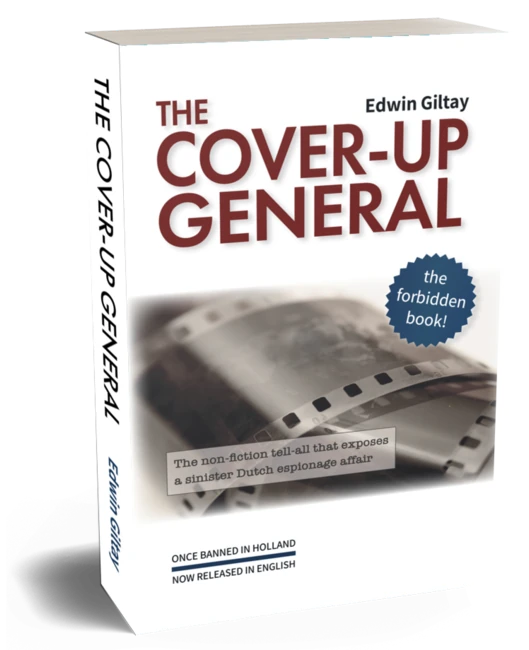
This page is an exhibit to the book The Cover-up General by Edwin Giltay and its accompanying website.