Exhibit · Judgment
Court of Appeal of The Hague, judgment of 27 June 2017, ECLI:NL:GHDHA:2017:1761
The passage
“rules that the State acted wrongfully I. by facilitating the separation of the male refugees by the Bosnian Serbs on 13 July 1995 by letting the refugees go to the buses in groups and through ‘the corridor’, and II. by not offering the male refugees who were inside the compound on 13 July 1995 the choice to stay within the compound, thereby denying them the 30% chance of not being exposed to inhumane treatment and executions by the Bosnian Serbs;” The operative part of the judgment, under the heading ‘Ruling’ (Dutch: ‘Beslissing’). The operative part applies in both cases and in the principal appeal as well as the cross-appeal: the surviving relatives and the State each appealed against the 2014 judgment (the principal appeal), and each in turn lodged an appeal in the case brought by the other (the cross-appeal). According to the court, some 350 male refugees were on the compound (para. 42.2). The wording is the court’s own official English translation, published separately as ECLI:NL:GHDHA:2017:3376; the Dutch original is below. The Court of Appeal first set aside the District Court judgment of 16 July 2014. The reasoning behind the thirty per cent is in paras 68 and 69.1.
Original wording
“verklaart voor recht dat de Staat onrechtmatig heeft gehandeld I. door op 13 juli 1995 de afscheiding van de mannelijke vluchtelingen door de Bosnische Serven te vergemakkelijken door de vluchtelingen in groepen en door ‘de sluis’ naar de bussen te laten gaan, en II. door de mannelijke vluchtelingen die zich op 13 juli 1995 op de compound bevonden niet de keus te bieden om op de compound te blijven en hun aldus de kans van 30% te onthouden om niet te worden blootgesteld aan de onmenselijke behandelingen en executies door de Bosnische Serven;” In the source, declarations I and II appear on two lines; they are joined here with a space. ‘De sluis’, literally ‘the sluice’, is rendered as ‘the corridor’ in the court’s own English translation.
Why this document matters
This is the judgment in which the Court of Appeal of The Hague put the State’s liability in the Mothers of Srebrenica case at thirty per cent. The court held that Dutchbat had made it easier for the Bosnian Serbs to separate the male refugees. According to the court, Dutchbat had also failed to offer the roughly 350 men on the compound the choice of staying there, and had thereby denied them a thirty per cent chance of escaping inhumane treatment and execution. Two years later the Supreme Court reduced that share to ten per cent.
In their statement of appeal in these same proceedings, the relatives’ lawyers cited The Cover-up General. They referred to four pages of the book for the claim that Dutchbat officer Johannes Rutten’s film roll had not failed and that the photos have been withheld ever since.
Provenance
- Document
- Judgment on appeal (arrest) in the Mothers of Srebrenica case
- Court
- Court of Appeal of The Hague, Civil Law Division
- Date
- 27 June 2017, delivered in open court
- Case numbers
- 200.158.313/01 and 200.160.317/01
- District Court case number
- C/09/295247 / HA ZA 07-2973
- Case-law identifier
- ECLI:NL:GHDHA:2017:1761
- Official English translation
- ECLI:NL:GHDHA:2017:3376
- Parties
- The Mothers of Srebrenica Foundation and ten individual appellants, all resident in Bosnia and Herzegovina, versus the State of the Netherlands (Ministry of General Affairs, Ministry of Defence and Ministry of Foreign Affairs)
- Counsel
- M.R. Gerritsen, Haarlem, for the Foundation and others; G.J.H. Houtzagers, The Hague, for the State
- Bench
- G. Dulek-Schermers, S.A. Boele and E.M. Dousma-Valk
- Subject
- State liability, acts of the UN, effective control, ultra vires acts; no direct effect of the Genocide Convention; jurisdiction under the ECHR and the ICCPR; tort, causation, declaratory judgment, loss of a chance; non-public documents; family members under article 6:108 of the Civil Code
- Judgment appealed
- District Court of The Hague, 16 July 2014, ECLI:NL:RBDHA:2014:8562 (English translation ECLI:NL:RBDHA:2014:8748)
- Cassation
- Supreme Court of the Netherlands, ECLI:NL:HR:2019:1223
- References
- Operative part under ‘Ruling’; paras 68 and 69.1
- Language
- Dutch
- Published in
- Rechtspraak.nl; AR 2017/3320; NJF 2017/466; PS-Updates.nl 2017-0547
- Held by
- Council for the Judiciary (Raad voor de rechtspraak), deeplink.
rechtspraak. nl/ uitspraak? id= ECLI: NL: GHDHA: 2017: 1761 - Archived copy
- Wayback Machine, 7 October 2022
- See also
- Mothers of Srebrenica, statement of appeal, 7 July 2015Supreme Court of the Netherlands, judgment of 19 July 2019, ECLI:NL:HR:2019:1223
Cited in:
- the essay ‘The Ban Fell, the Book Stood’ in the chapter (5) ‘More Than a Banned Book’ and in the slide ‘Supreme Court · 2019’ of the slideshow ‘The story on the map’
- the Voices section under the heading ‘Legal Victory’.
Document: https://
Archived copy: https://
Accessed 19 November 2026.
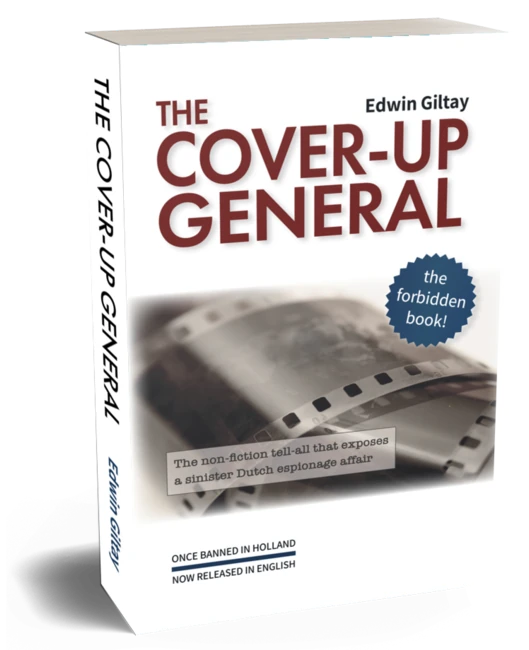
This page is an exhibit to the book The Cover-up General by Edwin Giltay and its accompanying website.