Exhibit · Report
NIOD report on Srebrenica, 2002
Briefing by Major De Ruyter
“Important for the picture that Dutchbat III formed of the situation on the ground was the briefing given by the military security officer Major De Ruyter. According to Warrant Officer W. Dijkema, during the training [De Ruyter] taught the classes that the population of the enclave consisted of ‘nothing but scum’. In the Balkans things were quite different from at home, and ‘the Balkan man’ was literally cast as ‘the Other’.” Page 1489, the paragraph beginning “Belangrijk voor de beeldvorming”, in Part II, chapter 8, section 3, on stereotypes and the training. Translated from the Dutch; the original wording is below. The report is set in justified lines and words are broken at the line ends; the breaks inside ‘voor-lichting’ and ‘adju-dant’ have been closed up here. The Dutch ‘adjudant’ is a warrant-officer rank, and ‘de Balkan-mens’, rendered above as ‘the Balkan man’, is the report’s own name for the stereotype it is describing.
“Belangrijk voor de beeldvorming over de situatie ter plaatse bij Dutchbat III is de voorlichting van de militaire veiligheidsfunctionaris majoor De Ruyter geweest. Volgens adjudant W. Dijkema leerde deze de klassen tijdens de opleiding dat de bevolking in de enclave uit ‘louter tuig’ bestond. Op de Balkan was het heel anders dan thuis en ‘de Balkan-mens’ werd letterlijk neergezet als ‘de Ander’.” Original wording
The motive for destruction
“Because it is so difficult to find a motive for the destruction of the roll in relation to what was known at the time, in July 1995, about the content of the photos – the bodies in particular played a part as ‘evidence’ of war crimes – the suspicion of a different basis later arose. The roll also contained shots of the separation of men and women and the role of Dutchbat soldiers in it. These were therefore extremely compromising photos for Dutchbat, the Netherlands and above all for the responsible authorities in the country, who were precisely engaged in letting the role of Dutchbat retain, if possible, at least a little lustre, and otherwise still portraying the battalion as a victim and not as an accomplice. According to that reasoning, the disappearance of those photos was very much in the interest of the authorities. […] On closer inspection, however, there is a serious objection here too. This reasoning presupposes, after all, that those who initiated the destruction of the film roll knew that it contained photos of complicity in the separation of men and women. That is not very likely. […] To accept this motive as a basis, it is therefore actually necessary to assume that the photos had first been seen by the destroyer or by whoever commissioned the destruction.” Pages 3026 and 3027, from the discussion of motives in Part IV, chapter 8, section 4, on the failed film roll. Omitted are an intervening sentence in which the report notes the absence of direct and concrete indications, and the explanation that Rutten, in his conversations about what was on the photos, initially made no mention of the separation. The report breaks words at the line ends; those breaks have been closed up here, and a note number has been left out. Translated from the Dutch; the original wording is below.
“Omdat voor de vernietiging van het rolletje zo moeilijk een motief is te vinden in relatie tot wat toen, in juli 1995, bekend was over de inhoud van de foto’s – vooral de lijken speelden als ‘bewijs’ voor oorlogsmisdrijven een rol – is later het vermoeden van een andere grondslag opgekomen. Op het rolletje zaten ook opnamen van het scheiden van mannen en vrouwen en de rol van Dutchbatters daarbij. Dat waren dus uiterst compromitterende foto’s voor Dutchbat, Nederland en vooral voor de verantwoordelijke autoriteiten in het land, die nu juist bezig waren de rol van Dutchbat zo mogelijk nog een beetje glans te laten behouden en het bataljon anders toch als slachtoffer en niet als medeplichtige af te schilderen. Het verdwijnen van die foto’s was volgens die redenering wel degelijk in het belang van de autoriteiten. […] Bij nader inzien is er ook hier toch een ernstig bezwaar. Deze redenering veronderstelt namelijk dat bij de initiatiefnemers van de vernietiging van het fotorolletje bekend was dat er foto’s over de medeplichtigheid van het scheiden van mannen en vrouwen op stonden. Dat is niet erg waarschijnlijk. […] Om dit motief als grondslag te aanvaarden is dus eigenlijk nodig te veronderstellen dat de foto’s door de vernietiger of diens opdrachtgever eerst waren gezien.” Original wording
Conclusion on the film roll
“The film roll of Lieutenant J.H.A. Rutten never yielded any photographs. A careful reconstruction of the events, based on several investigations from the day the development failed until very recently, leads to the conclusion that a human error was the cause. […] But all of that remains hanging in mid-air for lack of concrete evidence. Against the well-founded explanation of human failure, this hypothesis of deliberate destruction therefore does not hold up.” Pages 3027 and 3028, from the conclusion of Part IV, chapter 8, section 4, on the failed film roll. The omitted text discusses the suspicion of intent and the motives put forward for it. Translated from the Dutch; the original wording is below.
“Het fotorolletje van luitenant J.H.A. Rutten heeft nooit foto’s opgeleverd. Nauwgezette reconstructie van de gebeurtenissen op basis van verscheidene onderzoeken vanaf de dag van het mislukken van de ontwikkeling tot zeer recent, leidt tot de conclusie van een menselijke fout als oorzaak daarvan. […] Maar dat alles blijft in het luchtledige hangen bij gebrek aan concrete bewijzen. Tegenover de wel stevig onderbouwde verklaring van menselijk falen houdt deze hypothese van opzettelijke vernietiging dan ook geen stand.” Original wording
Why this document matters
The NIOD report, the official government-commissioned inquiry into the fall of Srebrenica, records, on the word of Warrant Officer W. Dijkema, that the military security officer Major De Ruyter taught the soldiers of Dutchbat III during their training that the population of the enclave consisted of “nothing but scum”. According to the essay, this counter-intelligence major took receipt of the roll of film.
The report of the internal MID investigation, dated 12 February 1999 and signed by Major R.F.J.H. de Ruijter, records the interview with Overduyn on 11 February 1999 in which she shared the view of her Casema colleagues that Giltay was “completely insane”. National Ombudsman report 1999/507 includes the MID report as part of the Minister’s position. That it was the same Major De Ruyter who interviewed her is stated in the book (pp. 56 and 64).
In the same report, the NIOD concludes that Lieutenant Rutten’s film roll never produced any photographs because of a human error, and that the hypothesis of deliberate destruction does not hold up for lack of concrete evidence. The Minister of Defence relied on that conclusion in 2017 in his reply to the House of Representatives about the book. According to the same report, the roll also contained “shots of the separation of men and women and the role of Dutchbat soldiers in it”. The NIOD considered it unlikely that those photos were a motive for destroying the roll: whoever destroyed it for that reason would first have had to see the photos. The report makes no mention of Giltay’s criminal complaint of 2000, in which he recorded that, according to Overduyn, the development had not failed and that she had reportedly seen the photos herself.
Provenance
- Document
- Three passages from the report of the independent historical inquiry into the fall of Srebrenica: Volume II, Part II, ‘Dutchbat in de enclave Srebrenica’, chapter 8, ‘Peacekeeping en humanitair optreden’, section 3, ‘Stereotypen, de opleiding en “de Balkan-mens”’; and Volume III, Part IV, ‘De gevolgen en de nasleep tot eind 1995’, chapter 8, ‘De “affaire Srebrenica” in het publieke domein’, section 4, ‘“Er staat niks op”: een fotorolletje mislukt’
- Title
- Srebrenica, een ‘veilig’ gebied. Reconstructie, achtergronden, gevolgen en analyses van de val van een Safe Area
- From
- Nederlands Instituut voor Oorlogsdocumentatie (NIOD), Amsterdam; final responsibility J.C.H. Blom, director, and P. Romijn, head of research
- To
- The Dutch government, which commissioned the inquiry; the terms of reference are recorded in Parliamentary Paper 25 069, no. 1, parliamentary year 1996–1997, and are annexed to the report
- Author
- The report’s own statement of authorship attributes the text of Part II, chapter 8 to T. Frankfort, and that of Part IV, chapter 8 to R. van Uye, with contributions by J.C.H. Blom, P.C.M. Koedijk and J. Vermolen
- Publisher
- Boom, Amsterdam, 2002; copyright Nederlands Instituut voor Oorlogsdocumentatie, Amsterdam
- Source of the passage
- For p. 1489 the report cites an interview of 21 September 1998 with Warrant Officer W. Dijkema, note 29 on the same page; pp. 3026–3027 discuss a motive for destruction that was put forward later, and the conclusion on pp. 3027–3028 closes section 4, for which the NIOD spoke with some 25 people about the film roll
- Date
- 10 April 2002, the day the report was presented; the colophon carries only the year 2002
- Subject
- The preparation and training of Dutchbat III, and the picture of the population of the enclave that was conveyed in the process; the failure of Lieutenant Rutten’s film roll
- Language
- Dutch
- Published in
- Volume II, p. 1489, and Volume III, pp. 3026–3028; ISBN 90 5352 716 8
- Web address
- www.
inlichtingendiensten. , pages 1489 and 3026–3028 of 3368nl/ buitenland/ srebrenicarapportniod_nl.pdf - Archived copy
- Wayback Machine, 10 May 2024
- See also
- Internal investigation for the MID Chief of Staff, 12 February 1999National Ombudsman report 1999/507, 17 December 1999Criminal complaint filed with The Hague police, 12 June 2000Letter to Parliament from Minister of Defence Dijkhoff to Speaker Arib, 13 October 2017
Cited in: the essay ‘The Ban Fell, the Book Stood’ in the chapter (4) ‘A Cover-up with an International Dimension’.
Exhibit page: https://
Document: https://
Archived copy: https://
Accessed 19 November 2026.
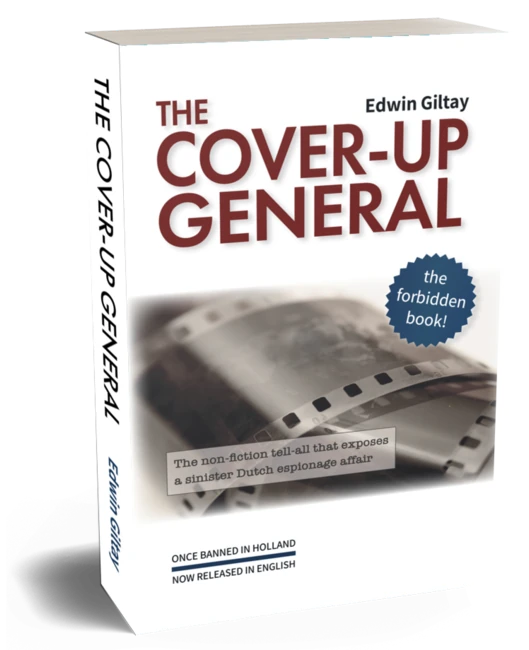
This page is an exhibit to the book The Cover-up General by Edwin Giltay and its accompanying website.