Exhibit · Letter
National Ombudsman to Giltay, with Giltay’s letter of 13 March 2018, 10 April 2018
The passage
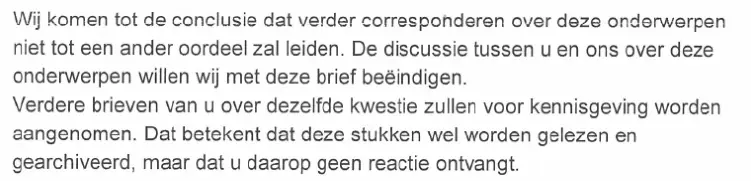
“We have come to the conclusion that further correspondence on these subjects will not lead to a different opinion. With this letter we wish to bring the discussion between you and us on these subjects to an end. Further letters from you on the same matter will merely be noted. That means that these documents will be read and archived, but that you will receive no reply to them.” Page 17, the middle paragraph of the letter. Translated from the Dutch; the original wording is below.
Original wording
“Wij komen tot de conclusie dat verder corresponderen over deze onderwerpen niet tot een ander oordeel zal leiden. De discussie tussen u en ons over deze onderwerpen willen wij met deze brief beëindigen. Verdere brieven van u over dezelfde kwestie zullen voor kennisgeving worden aangenomen. Dat betekent dat deze stukken wel worden gelezen en gearchiveerd, maar dat u daarop geen reactie ontvangt.” The Dutch phrase ‘voor kennisgeving aangenomen’ is an administrative formula: a document is registered as received and then filed without an answer.
Why this document matters
On page 17 of the PDF the National Ombudsman wrote to Giltay on 10 April 2018 that he saw no reason in Giltay’s letter of 13 March 2018 to revisit his “previously adopted position”. The Ombudsman did not address a single grievance, brought the discussion to an end, and announced that further letters on the same matter would be read and archived but not answered. For the new complaints about the Ministry of Defence, the reply referred Giltay to the Minister of Defence first, because the Ombudsman does not take up a complaint until the body complained about has had the chance to respond.
The same PDF opens with the letter of 13 March 2018, in which Giltay sets out nine grievances, attaches 19 exhibits and asks the Ombudsman to put the mistake right, to withdraw the disputed report and to explain that step publicly. The essay states that the ministerial characterisation of Giltay remains online today, in the National Ombudsman’s public report of 1999, and that in 2018, after the judicial rehabilitation, the institution refused to address his grievances on the merits.
Provenance
- Document
- Letter, page 17 of a PDF that also holds Giltay’s letter of 13 March 2018 to the National Ombudsman on pages 1–16
- From
- The National Ombudsman, The Hague, signed by Reinier van Zutphen, National Ombudsman
- To
- E.F. Giltay, The Hague
- Date
- 10 April 2018, from the date stamp in the margin
- Reference
- H201700015
- Subject
- “Reactie op uw brief” (‘Reply to your letter’)
- References
- Giltay’s letter of 13 March 2018; the Ombudsman’s earlier letters to him of 28 October 2015 and 7 March 2017; the Klachtenregeling Defensie (Defence complaints procedure)
- Also in this file
- Letter from Giltay to the National Ombudsman, 13 March 2018, on nine grievances against the Ombudsman and two new complaints about the Ministry of Defence, with a list of 19 exhibits
- Language
- Dutch
- Pages
- 1 page, being page 17 of the 17-page PDF
- Redactions
- In the reply the direct line, the name of the case officer and the signature are blacked out
- Held by
- Author’s archive
- See also
- National Ombudsman report 1999/507, 17 December 1999
Cited in:
- the essay ‘The Ban Fell, the Book Stood’ in the chapter (9) ‘Preserved Forever’
- the Voices section under the heading ‘False Psychiatrisation’.
Document: https://
Last modified 19 September 2026, accessed 15 November 2026.
This page is an exhibit to the book The Cover-up General by Edwin Giltay and its accompanying website.