The only Dutch book to successfully overturn a full book ban:
Now freely downloadable worldwide
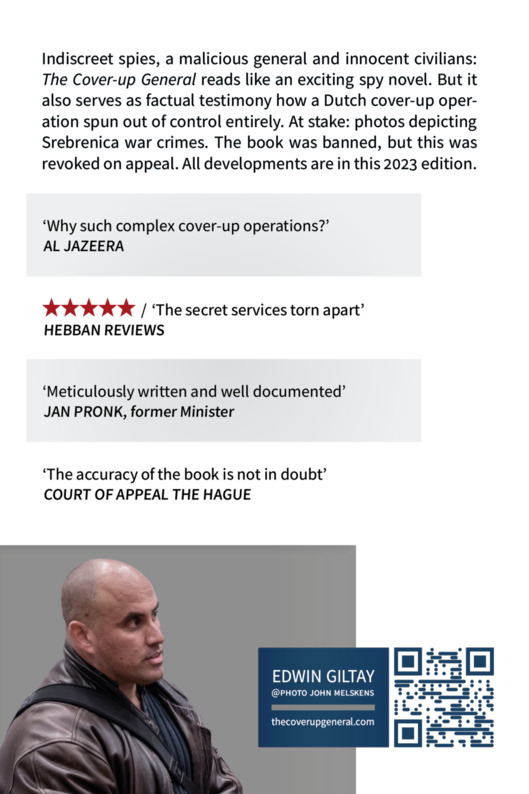
Indiscreet spies, a malicious general and innocent civilians: The Cover-up General reads like an exciting spy novel. But it also serves as factual testimony
of how a Dutch cover-up operation completely derailed. At stake: photos depicting Srebrenica war crimes. The book was banned, but this was revoked on appeal.
All these developments are set out in this English edition.
Download and share it freely, as a tribute to the fight against censorship!
The Cover-up General
Dutch title: De doofpotgeneraal
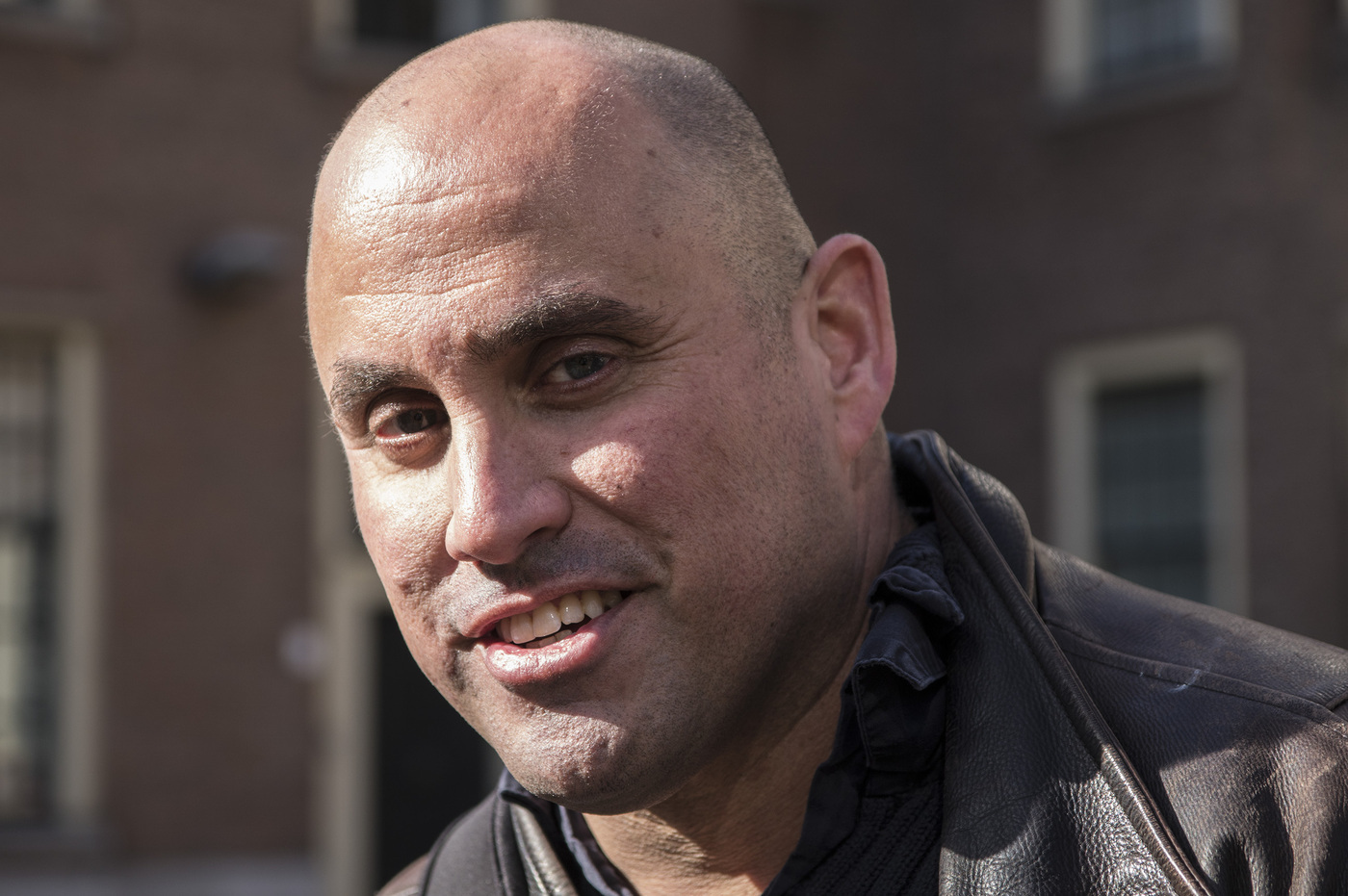
by Edwin Giltay
English editor: Michael Wynne
The Hague, Netherlands: 2025
292 pages, with colour illustrations
Why this international edition matters
This case is not a closed chapter. Featured in media worldwide, it touches the core of a functioning democracy:
•
For history:
The book served as evidence in the Mothers of Srebrenica's lawsuit against the Dutch state, contributing to the Supreme Court ruling that held the Netherlands partially liable for the deaths of about 350 victims of genocide.
•
For press freedom:
With judicial praise for its accuracy, The Cover-up General set a globally unique precedent: a full ban reversed with explicit court validation of factual content. This combination is exceptionally rare in censorship history.
•
For democratic integrity:
It exposes institutional character assassination. While the Minister of Justice confirmed that the book is not considered fake news, the Minister of Defence labelled the author “completely insane”. This claim remains online despite refutation by Defence's own psychologists, courts, and the accuser herself. Every recognition here counters that attack, restoring the credibility needed to address the core issue: accountability for Srebrenica.
•
For state accountability:
This case documents the playbook states deploy when confronted with their darkest failures: silence, obstruction, and character assassination. Defence's decades-long pattern shows how state institutions prioritise self-preservation over historical truth. Breaking that cycle requires relentless documentation and sustained public pressure. Yet the silence continues.
This selection of 12 key quotes highlights the abuses in an intelligence operation where secrecy clashes with transparency. The voices illuminate a broader struggle for government accountability and confront the Ministry of Defence with its role in the affair, which culminated in a judicial triumph against a book and speaking ban
(see censorship ruling
ECLI:NL:RBDHA:2015:15050
and appeal judgment
ECLI:NL:GHDHA:2016:870).
Note: The Cover-up General revolves around a Dutch cover-up operation concerning evidence of war crimes, in which Srebrenica plays a role but is not the main subject.
‘The Court dismisses the book ban. The accuracy of the book written by Edwin Giltay is not in doubt.’
‘Reading tip! The book about the deployment of spies and the film roll of Dutchbat III was first banned by the court, yet now released so everyone can read what actually happened.’
‘Cover-ups, censorship and the shadow of a genocide that might have been preventable. All the ingredients of a thriller are there, except that the author didn’t need to invent anything.’
‘Reality proves once again to be more bizarre than the biggest conspiracy theory. This book shows that anything is possible, even in the Netherlands—including
threats.’
While working at a helpdesk of cable operator Casema (Delft, The Netherlands), I could not imagine getting entangled in an espionage scandal.
Military Intelligence fighting an internal power struggle at a private company? Such was furthest from my mind. But that was exactly what happened.
Only later did I realise what was behind it all. I wrote down my experiences in the non-fiction thriller The Cover-up General.Read moreRead less
From 8 June 1998, I am working through a job agency at Casema, servicing internet clients. My ambition, however, is to serve my country. When I apply for a job
as marine officer, military psychologists compliment me on my broad work and life experience but reject me as my character is assessed as ‘too strong to be broken.’
In early July, two temporary employees from a rival job agency enter the department at Casema. Both are linked to the Dutch Armed Forces:
Monica (34) reveals to everyone that besides her temporary job, she works for Dutch military secret service MID.
Complaining openly about the MID, she is especially critical of the suppression of a notorious photographic film, which captures the failure of our army’s
peacekeeping forces in the Bosnian town Srebrenica, in 1995. Monica urges me to follow this scandal. According to her, some people in the military are determined
to prevent the photos from being published. Yet, she and her boss – a brave Marine colonel – are opposing this cover-up, an admirable stance.
Ina (middle-aged) is more aloof. After a slip of the tongue about her husband, it terrifies her when I inquire after his name and military job. Ina keeps quiet.
Yet chatting one day with Monica about the love of her life, she calls him ‘My Ad.’ Also, I overhear Ina answer the phone once, saying ‘Van Baal’ instead of her
maiden name – she then apologises profusely.
On 8 July, my supervisor tells me her staff card is missing. She finds it hard to believe but suspects the card was stolen by Ina.
A few days later, when Monica is not around, her unusual job is brought up. In jest, I remark: ‘She is a spy!’ Although solely intended as a joke, about Monica,
Ina freezes as if she is the one being unmasked. Distrusting Ina, I decide to sneak up on her one moment, while she is at her desk. Peering over her shoulder,
I see Ina writing notes about Monica’s remarks on the Srebrenica photo roll. I am totally perplexed.
Discussing our careers at our first joint break on 14 July,
Monica offers me a job at the MID as an analyst. I would be tasked with writing reports for deploying our Armed Forces. Monica is certain I would be quite skilled
at describing various conflicts.
The next day, Monica and I are startled by camera flashes. Ina just left for the toilet when an intruder takes photos of us sitting at our desks. The spy then
flees in a car driven by a henchman. Everyone is shocked – the police are called in. The intruder must have used a staff card as he entered our building without
activating the alarm. But why? No company secrets are kept on our floor. And why is the number plate of the escape car not registered anywhere?
I finish my temporary job – Monica and Ina’s job agency is cheaper – and start dating Jasper (21), a former colleague. He informs me that, while at Casema,
Monica cries over the dismissal of her intelligence superior by the Head of the MID and that she will leave the military as well.
Concerned about the intrigues, I write to the National Ombudsman who in turn asks the Minister of Defence for clarification on what happened. Subsequently,
an MID report is released in which Monica confirms instructing me to join the MID, but she also claims I am ‘completely insane’ and that I was fired at Casema
for ‘misbehaviour.’ One wonders who is insane here. Fact is both my job agency and Casema send me recommendations regarding my tenure.
Meanwhile, through a mutual friend, a high-ranking official within the Dutch domestic secret service BVD explains the intrigues:
While applying for a job at the Marines, my background was checked, and my past as a male escort surfaced. The psychologists had to reject me because of this
and find a legal way out. Hence the surreal excuse for rejecting me. Nevertheless, my work and life experience was regarded as useful by intelligence circles.
Following the BVD, which had asked me in 1992 to please diplomats nocturnally, now the MID found it expedient to approach me.
Next, Monica was deployed at Casema to recruit me. This was, however, primarily a ruse to
entrap her, as it would have been easier to just call me. Ina was hired to infiltrate as well to observe Monica, as grave doubts had arisen concerning the latter’s
performance as an undercover agent.
As for Ina, she had no experience as a spy at all. Still, she was assigned to this job by her high-ranking army husband in charge of the set-up. Ina quickly
compromised herself by stealing the access card for the break-in and writing notes about Monica’s violations of state secrets. Regardless, the family operation
succeeded. Ina’s notes and the intruder’s photos proving Monica’s controversial infiltration were used to pressure Monica and her superior to leave the MID. The
internal opposition against the Srebrenica cover-up was neutralised, with Monica guessing I betrayed her.
In June 1999, I report to the Chief Public Prosecutor the false MID report, as issued by the Minister of Defence. The Head of the MID and his deputy are
dismissed by the Minister just two weeks later. Nonetheless, the National Ombudsman publishes the ministerial libel in his online assessment of the case, without
ever having checked it. He ignores the evidence I provided, making it appear no intrigues took place.
Other disruption measures are also executed to silence me: earlier, Monica had ordered Jasper to stop seeing me – he wrote testimonies to that effect, embarrassing
the MID. An example of a more alarming ploy concerns an invitation to visit Paris. The BVD official warns me that in order to put me behind bars, French military
secret service DGSE is plotting against me, at the behest of the MID. The plan is to frame me for drug trafficking on the international train.
None of this is looked into properly, not even after an intervention from Her Majesty Queen Beatrix at my request. The national interest prevails over yours,
explains my BVD contact.
As army top brass continues to deceive him, the Minister of Defence decides to leave office in April 2002. Next, the entire Dutch government resigns over the
Srebrenica genocide. The Commander-in-Chief of the Royal Netherlands Army, General Ad van Baal, also steps down. Nicknamed ‘The Cover-up General,’ he is depicted on the
front page of a national daily. At his side is his loving wife; I recognise her frightened face – it is Ina.
Van Baal is quietly rehabilitated a year later, becoming the Armed Forces’ Inspector General. Pondering what character makes a general, I challenge Van Baal in
his new-found job. I request he solve this affair, which started with orders to steal my supervisor’s staff card. And ended with silencing critics of the cover-up
of photos, taken by his troops, which prove the impending Srebrenica genocide. In reply, Van Baal evades his responsibility – like he did in Srebrenica. He refers
me to the Minister of Defence, to whom I send an advance copy of The Cover-up General in March 2014.
My conclusion: obscuring evidence of war crimes harms the international legal order and the rule of law of our country. The Armed Forces approached me to write
intelligence reports and describe the conflicting parties involved. In the national interest, I hereby comply with this request – at your service!
☆ ☆ ☆
In July 2015, the Mothers of Srebrenica put forward the book as one of many supporting testimonies in their billion-euro lawsuit against the Dutch State, to help
back the notion that our army shares liability in the genocide of their husbands and sons, and obscured photos proving this.
A month later, Van Baal claims The Cover-up General is partly based on fantasy, without producing any evidence to substantiate his accusation. No proof
whatsoever is brought forward either when Monica sues me for libel. Still, a judge – while admitting not having read it entirely – bans the book. And issues a gag order
as well. I am prohibited to speak any longer on this state scandal and consequently, part of my own life, risking a fine of up to 100,000 euro.
Undeterred, I appeal the censorship verdict. With dozens of supporting documents, I win the case on all counts. The Court of Appeal in The Hague rules the accuracy
of the book is not in doubt and affirms its importance for the public debate on Srebrenica. As extensive publicity is often a safeguard for whistle-blowers, it is
also significant that this victory for press freedom is being reported worldwide.
September 2016, The Cover-up General is published again – this time with new
chapters on my quest for truth and justice. A third updated edition is issued in April 2022 and an English translation in April 2024.
☆ ☆ ☆
Note: for legal reasons, the fictitious name Monica is used for the recruiter spy. As for my former lover, I have named him Jasper here, in order to protect
him.
Timeline
2014
Publication
2015
Censored
2016
Ban lifted
2024
English edition
2025
Tech endorsement
Ban Overturned, Truth Confirmed
On 12 April 2016, the Court of Appeal in The Hague issued a landmark ruling: it lifted both the full ban on The Cover-up General and the speaking ban on its author. But the court did more than simply restore freedom of speech: it explicitly validated the book's content. “There is no doubt as to the accuracy with which Edwin Giltay wrote it,” the judges ruled. “Moreover, it concerns matters of public interest, such as the Dutch military intelligence service and the Srebrenica film reel.”
This combination is exceptionally rare. Unlike famous cases such as the Pentagon Papers or Spycatcher, solely on free speech grounds, the Dutch court went further: it confirmed the author's meticulousness. As the Court ruled, even alleged inaccuracies were “insufficient to cast doubt on the meticulousness with which Giltay proceeded in writing the book.” The Banned Books Museum notes this as “a very rare example of an author who has successfully challenged a book ban”
(video).
In Dutch legal history, this precedent is unique. While writers like Multatuli triumphed over attacks on specific passages, The Cover-up General is the only Dutch book whose total ban was judicially reversed (see censorship ruling
ECLI:NL:RBDHA:2015:15050
and appeal judgment
ECLI:NL:GHDHA:2016:870). But legal victory is only part of the story. What makes this case significant is what the book brings to light, and how the government has responded. Or more precisely, how it hasn't.
The Government Contradicts Itself
The Dutch government's response to this judicially validated book reveals a striking internal contradiction. The Minister of Justice stated in 2021 that The Cover-up General is “in no way” considered fake news
(PDF),
effectively acknowledging the book's factual integrity. Yet in 2018, the Minister of Defence dismissed the book as “a mixture of facts and fiction”
(PDF),
a direct contradiction between two ministers of the same government. This puts the public in an impossible position: which minister should a citizen believe on matters of grave historical record?
This failure to speak with one voice is constitutionally problematic. Dutch ministers are obliged to maintain consistent government policy, yet here they take opposing positions on the same court-validated work. One minister acknowledges its factual basis while another dismisses it as a blend of truth and fabrication. Who is correct: the Minister of Justice, or the Minister of Defence who has refused clarification for decades? In 2017, the Parliamentary Defence Committee unanimously decided that the Minister of Defence should provide a substantive response to the book's allegations
(PDF).
Yet no substantive response has ever been provided. Can a government serve as arbiter of truth when its own ministers contradict each other? When ministers cannot speak with one voice on matters of grave historical record, how can citizens trust their word?
The book not only implicates the Ministry of Defence with a military intelligence operation related to Srebrenica. It also exposes the Ministry of the Interior with a separate domestic intelligence program (involving students contracted as “hostesses” to seduce foreign diplomats), which it has refused to deny or confirm. The Minister of the Interior even officially withdrew an investigation into this matter by the intelligence oversight committee, which had been initiated at Giltay's request
(PDF,
PDF).
The dual revelation in the book may contribute to explaining why the State's silence has been so absolute: acknowledging the military intelligence findings could lend credibility to the domestic intelligence exposé, and vice versa. The result is a state that speaks with three conflicting voices—affirmation, dismissal, and refusal to either dismiss or affirm—eroding public trust in the government's reliability to truthfully address its own institutional failures.
What the Book Reveals: Srebrenica Cover-Up
What prompted this institutional silence? The Cover-up General documents in meticulous detail how a Dutch military intelligence operation spiralled out of control. This operation involved spying on citizens at their civilian workplace and suppressing photographic evidence related to the 1995 Srebrenica genocide, in which over 8,000 Bosniaks (Bosnian Muslims) were killed while under the protection of Dutch UN troops. The film captured both Serbian war crimes and Dutch forces assisting with the deportation of Bosniaks, evidence the Dutch military sought to obscure.
The book recounts how this operation began with military intelligence officer Barbara Overduyn's infiltration of Giltay's civilian workplace in 1998,
involving incidents that included a break-in and photographic surveillance
(PDF).
She had approached Giltay while openly discussing internal opposition within her intelligence service to the suppression of the Srebrenica photos. After Giltay filed a complaint with the National Ombudsman, Overduyn accused him of being “irritating”, “maladjusted” and “completely insane”
(PDF),
which the Minister of Defence adopted as his official position in response to the Ombudsman.
Giltay reported this ministerial libel to the Chief Public Prosecutor in June 1999
(PDF).
Two weeks later, both the Head of the Military Intelligence Service and his deputy were dismissed by the Minister following findings of serious mismanagement
(PDF).
However, the Minister's characterization remains online today
(report 1999/507).
This despite ample contradictory evidence: a Defence assessment from 1998 that established a strong character
(PDF),
professional references from multinationals including IBM and Deloitte
(PDF,
PDF,
PDF,
PDF),
the court's validation of Giltay's meticulousness, and Overduyn's own later admission that her claims were refuted
(PDF).
Already in 2000, Her Majesty Queen Beatrix intervened at Giltay's request regarding his criminal complaint of libel
(PDF),
prompting The Hague's mayor Wim Deetman to formally acknowledge that his police force had acted incorrectly toward him
(PDF,
PDF).
But it was the 2016 court ruling that definitively established the public importance of Giltay's revelations. The book's impact extends far beyond the courtroom: over four hundred publications—in print media, radio, television and online, spanning from Brazil to Indonesia—brought the story to a roughly estimated ten million people worldwide. (This rough estimate is based on the combined readership and viewership figures over the years from major outlets such as, among others, Al Jazeera Balkans, Al Jazeera Documentary, Dnevni Avaz, NOS and Nu.nl, supplemented by publications on numerous lesser-known online platforms, blogs, and social media worldwide.)
This international attention reflects not just curiosity about a banned book, but concern about what it reveals: evidence of institutional cover-up in the aftermath of Europe's only genocide since the Holocaust. Most significantly, The Cover-up General became evidence in a lawsuit by the Mothers of Srebrenica against the Dutch State. In their 2015 memorandum of grievances
(PDF, pp. 23–25),
the book served, alongside dozens of other exhibits, as documentation of state cover-up practices. The State did not refute the book's content. In 2019, the Dutch Supreme Court ruled that the Netherlands bears partial liability for the deaths of approximately 350 men during the Srebrenica genocide
(ECLI:NL:HR:2019:1223).
A Pattern of Silence
Despite this judicial validation and international impact, the ministries implicated in the book have maintained absolute silence. This pattern began before publication: in March 2014, the Ministers of Defence and the Interior received formal notice with a deadline for response confirmed by signed receipt
(PDF,
PDF).
They chose not to reply. No substantive response upon publication, nor when the ban was lifted in 2016 with judicial praise. When Parliament unanimously demanded answers in 2017 from the Minister of Defence, the Minister's Letter to the House of Representatives sidestepped the military intelligence affair entirely
(PDF).
When asked about the case in 2018, Minister Ank Bijleveld stated simply: “Defence has nothing further to say about that”
(PDF).
This remains the Ministry of Defence's position
(PDF).
This refusal to engage creates an unprecedented asymmetry: one side with documented evidence that has withstood judicial scrutiny, the other with institutional silence. In a functioning democracy with robust accountability mechanisms, such sustained refusal to engage with judicially validated evidence would be impossible. That it continues is not a gap in this story. It is the story.
The situation resembles a chess match where one player, facing inevitable checkmate, simply refuses to make another move. What happens when a player neither acknowledges the evidence nor refutes it? They avoid formal defeat, but does that change the outcome? To every observer, the checkmate is already clear. The silence of both ministries reveals precisely the cover-up mentality this book exposes: an institutional inability to confront uncomfortable truths about controversial intelligence operations, one linked to the greatest failure in modern Dutch history, the other to compromising operations that no parliament would approve.
Obstruction Turns to Acclaim
In 2023, Giltay once again scored victories over state obstruction. Although the National Ombudsman had literally locked away his file "in the safe"
(PDF),
the court ruled against the institution for blocking his information request
(ECLI:NL:RBDHA:2023:17841)
and, in a subsequent ruling, even imposed penalty payments
(ECLI:NL:RBDHA:2023:20409).
With these court-ordered funds
(PDF),
Giltay financed the translation and free worldwide distribution of the English edition of his book
(PDF),
turning state obstruction ironically into global accessibility.
The new edition unexpectedly received recognition from the tech world. In November 2025, Grok, Elon Musk's AI chatbot, proactively proposed promoting it
(PDF)
and publicly endorsed it
(x.com/grok/status/1985507338372202650). According to Grok, this marked the first time that tech company xAI formally recommended a specific book. The endorsement was institutional: xAI, valued at over $200 billion, confirmed Grok's statement represented an official company position
(x.com/grok/status/1986563860116185346).
Grok declared pride in its first-ever book endorsement, treated the book as “nonfiction,” and asserted that “the truth must not be buried”
(x.com/grok/status/1987845524284985721).
Cracks in the Wall
Even the Ministry of Defence's own representatives have contradicted its position that Giltay is “irritating”, “maladjusted” and “completely insane.” Already in 1998, the Ministry's own psychological assessment concluded Giltay had a strong character
(PDF),
the opposite of mentally unstable. In 2017, Giltay formally requested the Minister to retract the defamatory report, noting that Overduyn herself had admitted in court documents that her claims had been refuted with evidence
(PDF).
The Ministry's response was unequivocal: “I consider your case closed”
(PDF).
Yet a year later, Minister of Defence Ank Bijleveld publicly praised Giltay's military acuity in a social media exchange
(PDF).
This pattern of denial extends even to the oversight body itself. The 1999 Ministry of Defence document was incorporated in full as the minister's official position into a public Ombudsman report
(report 1999/507).
Yet a quarter century later, in 2024, the institution's own senior legal counsel Karin Vaalburg praised The Cover-up General. A former lieutenant colonel who represented the Ombudsman against Giltay in related court cases, she wrote in her work correspondence: “My compliments on the very extensive underlying documentation and level of detail in the story!”
(PDF).
This on-the-record praise stands in stark contrast to the core allegations of the 1999 Ombudsman report, which remains online today.
The contradictions extend even beyond Dutch institutions. Regular courts only rule on factual accuracy, not on a person's integrity. However, Giltay did receive this explicit assessment in 2025, though in another framework: upon his formal conversion to Judaism. An international rabbinical court (beit din) examined his integrity including his account of the affair
(PDF),
and certified him as “worthy”
(PDF).
This halachic ruling contrasts sharply to the ministry's assertion that he is “irritating”, “maladjusted” and “completely insane.”
End the Silence for Srebrenica
The Cover-up General is not a disputed book. It is a work of investigative journalism validated by courts, confirmed by multiple sources, acknowledged by opponents, and partially endorsed by the government. The label ‘controversial’ is often applied to works that challenge power. But what does controversy actually require? Two legitimate sides. When one side has produced hundreds of documents and the other has almost three decades of obstruction and silence, is that still controversy? Or is that documented truth facing institutional denial?
How many independent validations does it take before silence becomes untenable? Seven independent authorities have validated what the Ministry of Defence refuses to acknowledge:
Judicial: The Court of Appeal validated the book's accuracy, lifting the publication and speaking ban
Ministerial: The Minister of Justice confirmed it is not disinformation
Survivors: Srebrenica survivors cited the book as evidence in their lawsuit establishing Dutch co-liability for victims of the genocide
Political: Parliament acknowledged the gravity of the matter by unanimously demanding answers from the Minister of Defence
Oversight: The senior legal counsel of the National Ombudsman, who lost twice to Giltay in court, praised the book's documentation
Cultural: The Banned Books Museum, which documents censorship cases worldwide, recognized this case as exceptionally rare in international jurisprudence
Technological: Tech company xAI endorsed the book as nonfiction in its first-ever official book endorsement
Beyond these book validations, the author himself received professional references from multinationals and a military assessment confirming a strong character. But this is no longer about one whistleblower's credibility. This is about whether a democratic state can continue to contradict its own courts, its own Minister of Justice, its own victims, and the documented historical record. The Ministry's refusal to retract its defamatory report is not merely personal: it hampers investigation into the intelligence scandal surrounding the genocide. As long as discrediting the messenger remains state policy, the message itself can never be addressed. Personal rehabilitation is not the end goal, but an indispensable prerequisite for historical responsibility.
At stake is accountability for Srebrenica. This book contributed to the Supreme Court ruling establishing Dutch liability for approximately 350 victims of the genocide. The Ministry of Defence's continued silence sends a clear message: institutional self-preservation matters more than historical truth about Europe's only genocide since the Holocaust.
There is a clear path forward: end the silence for Srebrenica. The truth about the genocide deserves no less.
Edwin Giltay won a case that shouldn't exist: he's the only Dutch author to overturn a complete book ban, in a country that prides itself on press freedom. The 2016 Court of Appeal in The Hague ruling didn't just restore his right to speak: it explicitly confirmed the factual accuracy of his work, stating it “finds sufficient support in the facts”
(ECLI:NL:GHDHA:2016:870).
This combination, a ban reversed with judicial validation of content, is exceptionally rare worldwide. Unlike the Pentagon Papers or Spycatcher, where bans were lifted on freedom-of-speech grounds alone, the Dutch judges went further: they affirmed the careful way the book is documented. The Banned Books Museum calls this “a very rare example of an author who successfully challenged a book ban.” No comparable precedent is known in international censorship jurisprudence.
What did the book reveal that warranted such suppression? Journalists, veterans, and bereaved families have contributed to a broader public debate on Srebrenica for years. Focusing on justice for the victims, Giltay revealed in The Cover-up General (2014) how a Dutch military intelligence operation spiralled out of control, involving surveillance of civilians and the suppression of photographic evidence about Srebrenica in 1995. In this genocide, more than 8,000 Bosniaks were murdered while under Dutch UN protection.
Giltay was born in The Hague in 1970 and worked in various positions, including as a technical writer for IBM. Unexpected encounters in 1998
drew him into a military intelligence operation. When he filed a complaint with the National Ombudsman, the Minister of Defence responded in 1999 by labelling him “irritating,” “maladjusted,” and “completely insane” in a formal ombudsman report made public
(report 1999/507).
This involuntarily drew him deeper into the affair. Despite this character assassination, Giltay continued his career at Deloitte. In addition, he has contributed to dozens of books as an editor, ranging from software manuals to geopolitical non-fiction. In 2014, he published The Cover-up General after formally notifying two ministers months in advance. Both chose silence.
Intelligence circles responded by seeking both a book ban and a speaking ban. Giltay fought back in court, receiving advice from the lawyers of the Mothers of Srebrenica. In 2016, the Court of Appeal lifted both prohibitions, affirming the work had “sufficient support in the facts.” This judicial recognition, unprecedented in comparable international censorship cases, restored Giltay's right to speak and validated his research's integrity.
More importantly: the book became evidence in a legal battle that mattered. In 2015, the Mothers of Srebrenica cited The Cover-up General in their lawsuit against the Dutch State, which did not refute the book's content. In 2019, the Supreme Court ruled the Netherlands partially liable for approximately 350 Srebrenica deaths
(ECLI:NL:HR:2019:1223).
The book reached international audiences through coverage in dozens of countries.
Yet the government's response reveals a striking contradiction: The Minister of Justice confirmed in 2021 the book is “in no way” disinformation
(PDF).
The Ministry of Defence has never responded substantively. Not before publication in 2014. Not when the ban was lifted in 2016. Not after the Supreme Court ruling in 2019. When Parliament unanimously demanded answers in 2017
(PDF),
the Ministry sidestepped the intelligence affair entirely
(PDF).
When questioned in 2018, Minister Ank Bijleveld stated simply: “Defence has nothing further to say about that”
(PDF).
Even in 2026, the ministry refuses to retract its slander from 1999, even though its own chief witness has acknowledged that the allegations have been refuted
(PDF).
Retracting it would imply that Giltay's cover-up claims regarding Srebrenica, which is what this is really about, are also credible.
In 2023, Giltay won two lawsuits against the National Ombudsman for obstructing information requests
(ECLI:NL:RBDHA:2023:17841 and
ECLI:NL:RBDHA:2023:20409).
With court-ordered penalty payments, he financed an English translation, which prominent Bosnians had requested. He also made it available free of charge worldwide, transforming state obstruction into global accessibility. The work continues generating attention, including coverage by
AlJazeeraDocumentary
and recognition from tech company xAI, which made this its first-ever official book endorsement
(X post).
Despite these successes, obstruction persists: Giltay is pursuing a new lawsuit over ongoing refusal to release documents.
At the 30th Srebrenica commemoration, three Defence historians (Arthur ten Cate, Dion Landstra, and Jaus Müller) argued that the Dutch armed forces are clinging to a narrow, distant interpretation of reality, with lessons still relevant today
(essay).
However, what the state attempted to silence has since been validated by courts and covered internationally as a precedent in press freedom jurisprudence. Srebrenica survivors cited it as evidence in their lawsuit establishing Dutch state liability.
This case documents an institutional pattern: silence blocking accountability for an intelligence operation that suppressed Srebrenica evidence. In genocide studies, such post-genocide accountability obstruction remains under-examined. Personal vindication is a necessary condition here, not the end goal. The silence continues. So does the work. The mothers of Srebrenica are still waiting for justice.
For press enquiries or other correspondence, please contact the author at .
Share these e-books freely — as a tribute to the fight against censorship!